
 Tree on the house?
 Not on the list?
Free with every estimate · Gainesville, FL
Tree Health Check in Gainesville, FL
A ground-up look at the trees that worry you: root flare, trunk, forks and crown, with a plain answer on each one. It is free with every estimate, and the notes can be put in writing.
Tree Health Check Gainesville FL: What We Look At
Most people ask for a check because something about a tree looks wrong: mushrooms at the base, a sudden lean, a crown that thinned out over one summer, or a crack after a storm. Others just bought a house under three big oaks and want to know what they are living with. Either way, the first look costs nothing. A hazard check is part of every free estimate, and the notes can be written up if you ask.
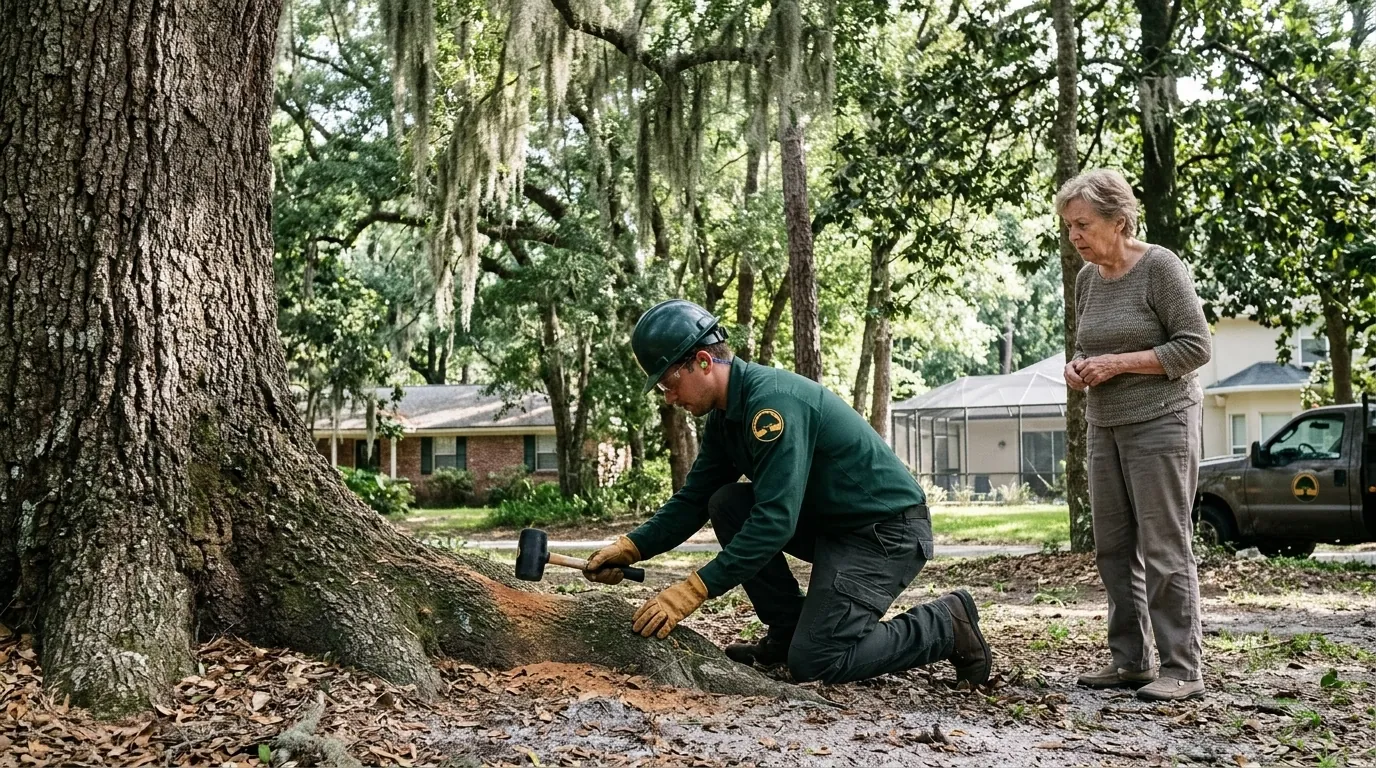
The check starts at the ground and works up. The root zone tells you a lot: soil heaving on one side of a lean, roots cut by a driveway or sewer repair, girdling roots wrapped around the trunk, or the shelf fungi that mark decay. Next comes the trunk, sounded with a mallet for hollow spots and checked for cracks, cavities and old wounds. Then the main limbs and forks, and finally the crown, where leaf color and density show how the tree is doing overall.
What you get
- A walk-around with you, explaining what we see on each tree and why it matters
- A plain answer for every tree: leave it, prune it, support it, watch it or remove it
- A sense of urgency, from 'this can wait a few years' to 'this should come down before summer storms'
- Written hazard notes on request, listing each tree, its condition and the recommended work
- A fixed, written price for any work you decide to have done
This is a practical, visual check by a working tree crew, not a formal certified risk assessment, and it does not involve specialized decay-testing equipment. If a tree needs that level of testing, or you need documentation for a permit exemption, we will tell you and help you arrange it.
Common Tree Problems an Arborist Looks For in Gainesville
Root and trunk decay in oaks
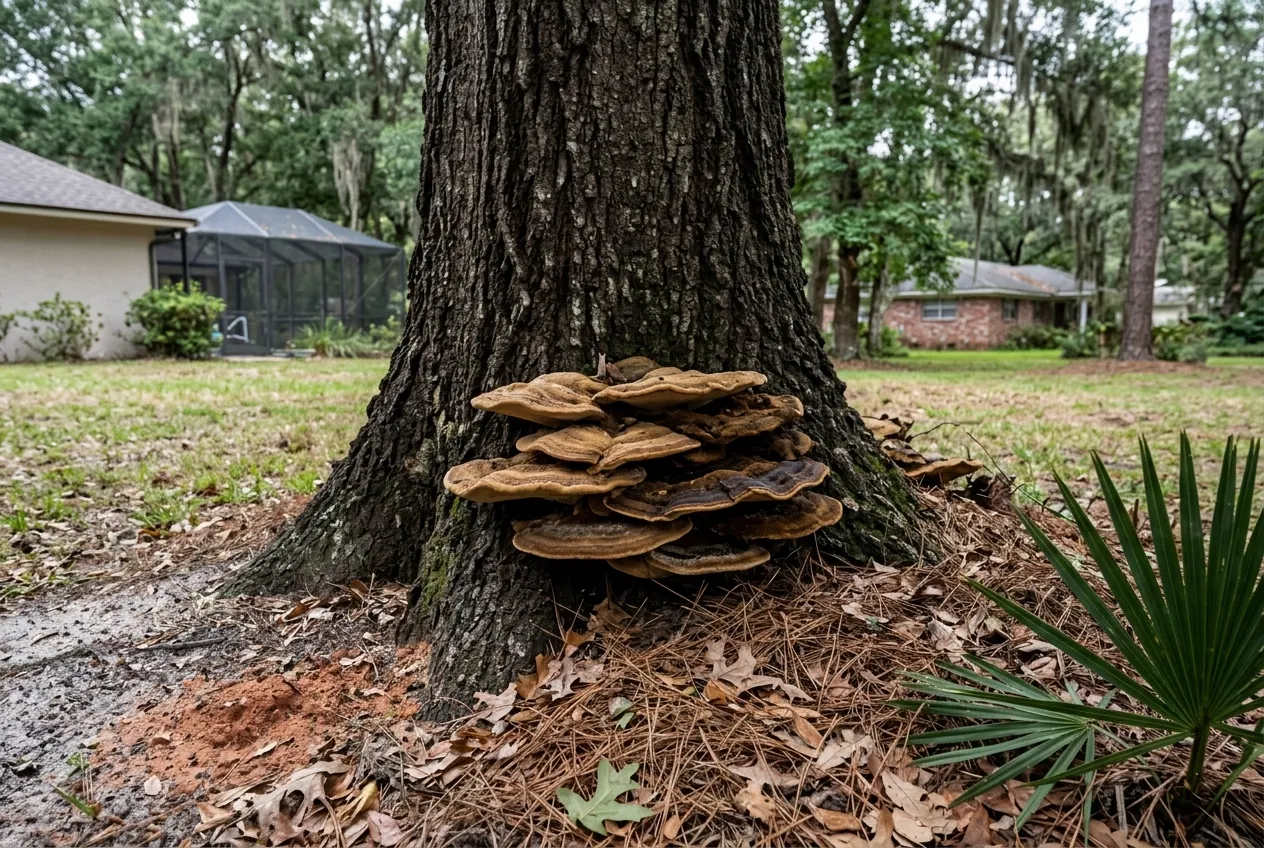
Laurel and water oaks are the trees most likely to hide rot here. Bracket-shaped fungi at or near the root flare often point to Ganoderma, a white rot that UF/IFAS associates with decay of the roots and lower trunk, especially on hardwoods such as oaks. Once conks appear, the decay is well established and cannot be reversed. A tree can look green and full on top while its base is hollowing out, which is why the check always begins at ground level.
Hypoxylon canker after drought
Gray or black crusty patches where bark has sloughed off an oak trunk are a sign of Biscogniauxia, still widely called hypoxylon canker. UF/IFAS describes it as a fungus that rarely harms vigorous trees but moves quickly through trees stressed by drought, root damage, compaction or construction, and oaks are the most susceptible. When that crust shows on the trunk, the tree is unlikely to recover, so it is worth watching closely after any long dry spell.
Bark beetles in pines
Drought-stressed loblolly and slash pines attract bark beetles. Small pitch tubes on the bark, fine reddish dust in the crevices and a crown fading from green to yellow are the giveaways. A pine at that stage cannot be saved, and the wood dries and turns brittle quickly. Our post on pine beetles and dead pines in Alachua County covers what to watch for.
Structure, roots and ground
Not every hazard is a disease. Tight forks with bark trapped inside, long overextended limbs, a lean that has changed since last year, roots severed for a new driveway or pool, and soil piled against the trunk are all structural risks. Alachua County's karst geology adds one more: sandy soil over limestone can shift, and a tree beside a depression or a low spot that keeps sinking deserves a closer look.
Palms and smaller trees
The same look applies to palms and ornamentals. A palm whose crown has shrunk to a few fronds, or one with a conk at its base, gets flagged, and so does a holly or crape myrtle that has died back in the middle. Small trees rarely threaten a roof, but they can still fall on a fence, a shed or a parked car, so they are worth a mention while we are on the property.
Tree Risk Assessment and Florida Statute 163.045
Florida law gives homeowners a specific path for removing a dangerous tree. Under Section 163.045 of the Florida Statutes, a local government cannot require a notice, application, permit, fee or mitigation for pruning or removing a tree on residential property if the owner has documentation that the tree poses an unacceptable risk to persons or property. The documentation has to come from an ISA certified arborist or a Florida licensed landscape architect. The statute covers a detached single-family home on a lot actively used that way, and it also bars local governments from requiring replanting.
The bar is specific. The tree must be assessed using the ISA's tree risk assessment best management practices, and removal has to be the only practical way to bring its risk below moderate. A crew's visual check, ours included, does not meet that standard on its own. What we can do is tell you whether a tree looks like it might qualify and help you arrange an assessment from a qualified professional who can sign the documentation. For the wider permit picture, read do you need a permit to remove a tree in Gainesville.
Without that documentation, the normal rules apply. Inside the City of Gainesville, a single-family lot only needs a removal permit for heritage trees: most species once they pass 20 inches in diameter measured 4.5 feet above the ground, and water oak, laurel oak, sweetgum and slash or loblolly pine once they pass 30 inches. High-quality species such as live oak and southern magnolia are regulated anywhere on the lot, while other heritage trees are regulated within the legal setback, and city permits are free. In unincorporated Alachua County, a home lot of an acre or less follows similar thresholds of 20 inches for native trees and 30 inches for laurel and water oaks, with mitigation planting or a fee possible.
Gainesville Tree Inspection Costs and What Comes After
The health check itself is free with any estimate, whether or not you end up hiring us. When it does turn into work, these are the ranges that usually follow.
| Job | Typical range | What moves the price |
|---|---|---|
| Hazard look-over and walk-through | Free | Included with every estimate |
| Written hazard notes | Free on request | Number of trees on the property |
| Deadwood pruning on a stressed tree | $175 – $900 | Tree size, amount of dead wood, access |
| Cabling or bracing a weak fork | $350 – $1,200 | Number of cables and rods, crown height |
| Removing a failing tree | $350 – $3,500+ | Height, what it would land on, crane need |
| Grinding the stump afterward | $95 – $450 | Diameter, roots, grinder access |
The point of the check is to spend money only where it matters. Many trees need nothing at all. Some need light pruning to take dead wood off, and a few need support from cabling and bracing. When a tree is failing, the removal is priced on the spot, along with an honest read on how urgent it is.
Tree Health Checks Across Alachua County Neighborhoods
Different parts of the county bring different questions. Haile Plantation is an unincorporated planned community of about 1,700 acres southwest of the city, so county tree rules apply and the association may want its own review before work starts. On established streets in Northwood and Huntington, a common question is whether a mature oak over the roof is still sound. Out in the towns, Newberry and High Springs each have their own codes, and checking them is part of every estimate there.
After a storm, a quick check is worth scheduling even if nothing fell. Cracks in forks, hangers caught in the upper canopy and roots lifted on one side are easy to miss from the porch. If the damage is already done, our storm damage cleanup crew handles hangers and broken tops, and the storm line is open around the clock for trees on structures.
To set up a look, call or text us or use the estimate form, and mention which trees worry you most. Health checks are available anywhere our Gainesville tree service works, including the surrounding towns.
Tree Health Check Gainesville Questions
Straight answers before you call.
Yes. A hazard look-over is part of every free estimate, with no charge and no obligation to hire us. We walk the property with you, explain what we see on each tree you are concerned about, and write up notes if you want them. You only pay if you decide to have work done.
We do not claim ISA certification. Our health check is a practical, visual inspection by a working tree crew. If you need a formal tree risk assessment, for example to use the Florida Statute 163.045 exemption on a dangerous tree, we can help you arrange one with an ISA certified arborist or a Florida licensed landscape architect.
On a single-family home lot, yes, if you have documentation from an ISA certified arborist or a Florida licensed landscape architect showing the tree poses an unacceptable risk under Florida Statute 163.045. Without it, City of Gainesville or Alachua County rules apply, and large heritage trees generally need a permit. Smaller trees on home lots usually do not.
Watch for fungus or conks at the base, bark falling off in patches, a crown that thins or browns early, dead limbs at the top, new cracks and a lean that keeps getting worse. On pines, pitch tubes and fine dust on the bark point to beetles. Any one of these is worth a look, and several together usually mean serious decline.
Yes. On request, the notes list each tree, its condition, the recommended work and how soon it should happen. That can help when an association asks for a reason before approving work. The notes describe what was observed during a visual check; they are not a certified risk assessment, and they say so.
For mature trees near the house, a look every couple of years is reasonable, plus a check after any major storm or long drought. Trees that had roots cut for construction deserve a look within a year or two, since decline can take time to show. Young, healthy trees in open spots need far less attention.
More Gainesville Tree Services
Other work we handle on the same visit.
Tree Removal
Full takedowns, rigged and lowered over whatever is underneath.
Oak Tree Removal
Laurel and water oaks at the end of their life span.
Pine Tree Removal
Dead, beetle-hit, lightning-struck or leaning pines.
Crane Tree Removal
Trees over the house with no safe place to lower wood.
Emergency Tree Removal
Trees on roofs, cars and fences, any hour.
Storm Damage Cleanup
Hangers, split trunks and yard debris after a storm.
Stump Grinding
Ground below grade so you can sod or plant over it.
Land Clearing
Lots, fence lines, invasives and overgrown acreage.
Get a Free Tree Health Check in Gainesville
Point out the trees that worry you. We will tell you which ones need work, which can wait and which are fine.