
 Tree on the house?
 Not on the list?
Gainesville · Alachua County, FL
Tree Removal in Gainesville, FL
Dead, decaying or simply too-big trees taken down in the way your yard allows: felled whole, lowered in sections, or lifted out by crane. One written price covers the cutting, the cleanup and the hauling.
Planning Your Gainesville Tree Removal
A removal starts with a walk around the tree, not a price sheet. We look at what the trunk is doing at the base, where the heaviest limbs point, what sits under them and how a truck reaches the yard. Those four things decide whether a tree comes down in one piece, gets taken apart rope by rope, or needs a crane. Then you get one number on paper that covers the cutting, the chipping and the haul-off.
This page is the overview. If your tree is a declining oak, a pine turning brown, or something resting on the roof right now, the pages on oak tree removal, pine tree removal and emergency tree removal go into the details of each. Start here for the general picture, including the question of whether the tree needs to go at all.
Three ways a tree comes down
- Felled whole. Needs open ground at least as long as the tree is tall, which is more common on the larger lots out toward Newberry and the western county than inside the city. It is the fastest and least expensive method.
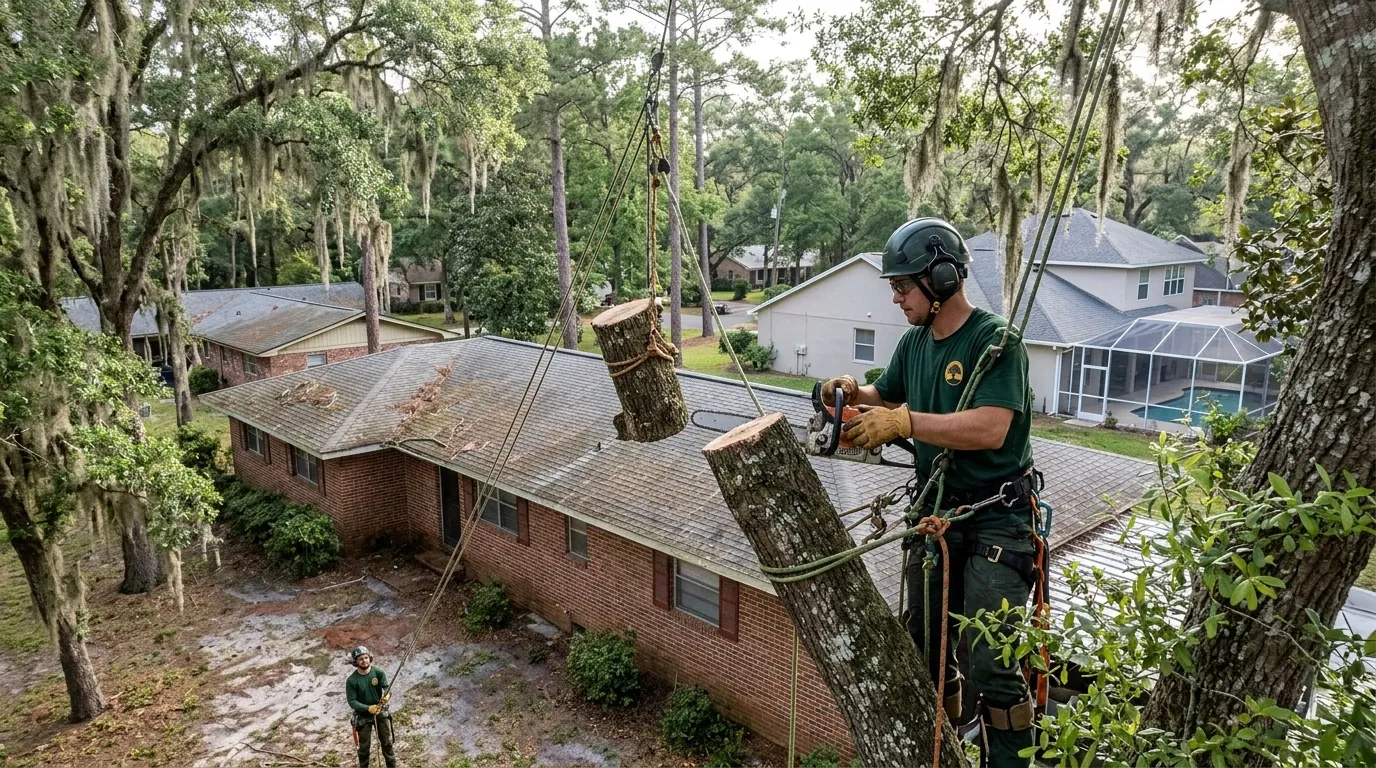
- Sectioned and lowered. A climber takes the tree apart from the top down, and each piece is lowered on a rope through a friction device so it lands where we choose. Most in-town yards, from Duckpond to Millhopper, get done this way.
- Crane-assisted. Pieces are picked up and swung out to the street when there is nowhere safe to lower them, or when the wood is too decayed to trust a climber on. The crane tree removal page explains that setup.
Tree Removal in Gainesville: When It Makes Sense and When It Doesn't
Good reasons to take a tree down are usually visible from the ground once you know where to look. A trunk with a cavity you can put a hand into, mushrooms or shelf fungus at the root flare, a lean that has gotten worse since last year, or bark sloughing off in sheets on a pine all point toward removal. So does a tree planted three feet from a foundation that will only get bigger, or an invasive camphor or Chinese tallow seeding into the rest of the yard.
Weaker reasons are the ones we push back on. A tree that drops a lot of leaves, has a few dead branches, or shades the grass is usually a candidate for tree trimming and pruning, not a chainsaw at the base. Healthy live oaks fall in that group more often than any other species here. If you are unsure, a free tree health check comes with every estimate, and we will put our reasoning in writing if you ask.
Gainesville Tree Removal Cost by Size and Setup
Height is the starting point, but the setup underneath a tree moves the price just as much. A 50-foot sweetgum in an open side yard is a half-day job. The same tree leaning over a screened lanai, with a gate too narrow for the chipper, takes more climbing, more rigging and more carrying. These are typical ranges for one residential tree with cleanup included.
| Job | Typical range | What moves the price |
|---|---|---|
| Small tree, under 30 ft | $350–$850 | Open ground versus a fence, shed or AC unit underneath |
| Medium tree, 30–60 ft | $850–$1,800 | How many limbs must be roped down over the house |
| Large tree, over 60 ft | $1,800–$3,500+ | Trunk diameter, internal decay, distance to haul wood |
| Crane-assisted add-on | +$600–$1,800 | Crane size, setup distance, street and driveway access |
| Emergency or after-hours add-on | +25–50% | Nights, weekends and active storm days |
| Stump grinding, same visit | $95–$450 | Stump diameter and how many surface roots you want out |
Your estimate turns that range into one fixed figure. It lists what is included, which is felling or rigging, chipping all brush, loading and hauling logs, and raking and blowing the work area. Stump grinding sits on its own line so you can take it or leave it. For a longer breakdown with examples, read how much tree removal costs in Gainesville.
Tree Removal Permits in Gainesville and Alachua County
Where the property sits decides which code applies. Inside the City of Gainesville, the Urban Forestry program's guidance for existing detached single-family homes says a tree under 20 inches in diameter, measured 4.5 feet off the ground, does not need a removal permit. Only Heritage Trees are regulated on those lots. Most species become Heritage Trees above 20 inches, but water oak, laurel oak, sweetgum, slash pine and loblolly pine do not reach that status until 30 inches.
Location on the lot matters too. The city's High Quality species, a list that includes live oak, southern magnolia, longleaf pine, pignut hickory and bald cypress, are regulated anywhere on the property once they reach Heritage size. A heritage tree of any other species falls under the permit rule only when it sits within the zoning setback. Homes in a planned development can have trees protected at any size if they were part of the approved landscape plan. The city lists no application fee for the permit itself.
In unincorporated Alachua County, the county's tree permitting page says single-family lots of one acre or less need a permit to remove native trees over 20 inches in diameter, laurel and water oaks over 30 inches, and any tree the county has named a specimen tree. Newberry, Alachua, High Springs, Archer, Micanopy, Hawthorne and Waldo each keep their own rules.
Florida Statute 163.045 overrides all of these in one situation. If the home is a single-family detached house and the owner has documentation from an ISA certified arborist or a Florida licensed landscape architect that the tree poses an unacceptable risk to people or property, the local government cannot require a permit, fee, mitigation or replanting. HOA covenants are a separate matter, and communities like Haile Plantation can still ask for architectural approval. Our tree permit guide for Gainesville walks through each case.
Removing Trees Near GRU and Clay Electric Lines
Plenty of Gainesville trees have wires running through them. The line from the pole to your house is the service drop. Gainesville Regional Utilities offers a free disconnect of that line to property owners and tree companies who need to work near it, so the crew can cut without the wire live. GRU also tells customers not to trim or remove anything within 10 feet of a power line on their own.
The higher-voltage lines running pole to pole are a different category, and only utility-qualified crews work near them. Parts of the county, especially on the west side, are served by Clay Electric Cooperative rather than GRU. We confirm which utility serves your address, set up the disconnect or line clearance before the work day, and plan the cut around it. More on that in trees near power lines in Gainesville.
Tree Cutting Service in Gainesville: The Work Day
- The crew arrives in the window you were given, walks the job with the estimate in hand, and marks where the chipper, trucks and drop zone will go.
- Ground mats go over soft turf and plywood over pavers. Pool screens, AC units and garden beds near the drop zone get covered or padded.
- The climber or crane takes the tree down in the method agreed on the estimate. Nothing changes method without talking to you first.
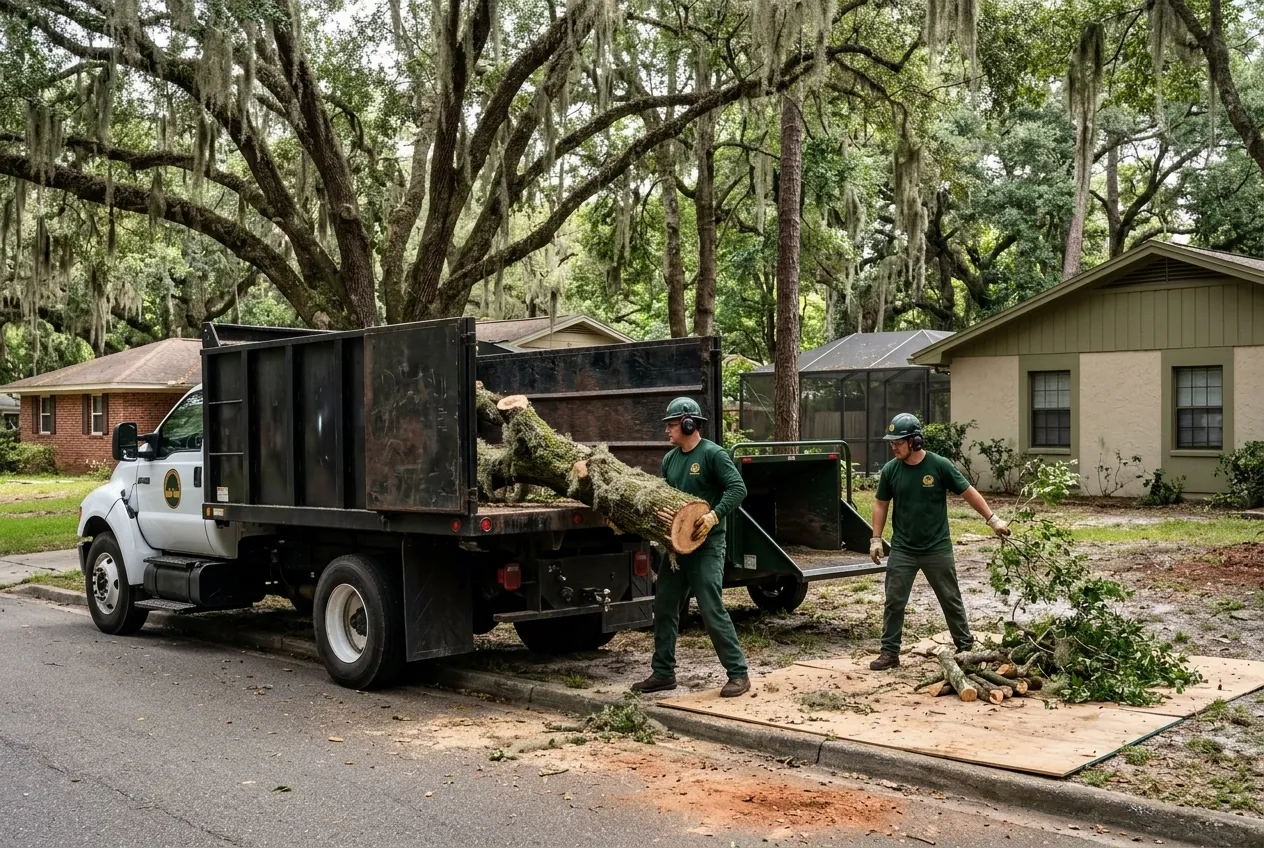
- Brush is chipped as it comes down. Trunk wood is cut to a size that can be carried or loaded without dragging it across the lawn.
- Wood, chips and debris leave on our trucks unless you asked to keep firewood rounds or a pile of mulch.
- Lawn, drive and roof edges are raked and blown, and you get a last look before we pull out.
After the tree is gone
A ground stump leaves a patch of soil and chips that settles over a few months, so most people top it with soil before sodding. If you are clearing several trees or an overgrown fence line at once, land clearing pricing may make more sense than separate removals. And if you plan to replant, our notes on the best trees to plant in Gainesville after a removal cover spacing from the house and from power lines.
Hiring a Tree Removal Company in Gainesville
A few questions sort out most crews quickly. Ask for a certificate of insurance before anyone climbs. Ask whether the price is fixed or an hourly estimate. Ask what happens to the wood, and whether the stump is in the quote or extra. Ask how they plan to protect whatever is under the tree. A good answer to that last one names a method, like roping limbs down or bringing a crane, instead of promising to be careful.
We are one local crew handling tree service across Gainesville and the surrounding county, and the estimate is how you judge us. It is free, it shows the method and the price, and it tells you plainly whether the tree has to come down. When you are ready, call or text us or send a photo through the quote form.
Tree Removal Gainesville Questions
Straight answers before you call.
Scheduling usually takes days, not weeks, unless a hurricane has just passed and every crew in the county is booked. If a permit is required, the city or county review adds time, so it helps to start that early. The removal itself is usually a few hours to a full day. Crane jobs need the crane booked too, which can add a short wait.
For an existing detached single-family home inside city limits, the City of Gainesville's guidance says no permit is needed for trees under 20 inches measured 4.5 feet up. Two exceptions to watch for: planned developments, where trees in the approved landscape plan can be regulated at any size, and HOA covenants, which follow their own rules. We check both before quoting.
Yes. Some customers keep oak rounds for a fire pit, logs for borders, or a pile of chips for mulch. Tell us during the estimate and we will cut the wood to the length you want and stack it where you point. Leaving wood can lower the price slightly because there is less to haul, and the estimate will show that difference.
A tree whose trunk straddles the line is generally treated as shared, so both owners should agree in writing before it comes down. When the trunk is fully on one side, that owner normally makes the call. We will not cut a tree until the person who signs the estimate confirms they have the right to remove it, and we can quote both neighbors together.
Usually. The crew, chipper and trucks are already on site, so the setup cost is spread across more trees. A second or third tree in the same yard often costs less than it would as its own job. If you are on the fence about a smaller tree, ask for it as an optional line on the estimate so you can see the difference.
It can change their conditions. Neighboring trees suddenly get more sun and more wind, and laurel oaks in particular can respond poorly to sudden exposure. We protect root zones from heavy equipment with mats and keep trucks off them where possible. If a remaining tree looks weak once the canopy opens up, we will mention it rather than wait for it to become a problem.
More Gainesville Tree Services
Other work we handle on the same visit.
Oak Tree Removal
Laurel and water oaks at the end of their life span.
Pine Tree Removal
Dead, beetle-hit, lightning-struck or leaning pines.
Crane Tree Removal
Trees over the house with no safe place to lower wood.
Emergency Tree Removal
Trees on roofs, cars and fences, any hour.
Storm Damage Cleanup
Hangers, split trunks and yard debris after a storm.
Stump Grinding
Ground below grade so you can sod or plant over it.
Land Clearing
Lots, fence lines, invasives and overgrown acreage.
Tree Trimming & Pruning
Roof clearance, deadwood out and crown raising without topping.
Get a Fixed Price on Your Tree Removal
Send a photo or book a visit. We'll look at the tree, check the rules for your address and give you one written number.