
 Tree on the house?
 Not on the list?
Gainesville neighborhood · 32605, 32606, 32653
Tree Service in Millhopper, Gainesville, FL
Tall pines on acreage lots, laurel oaks in the older subdivisions off NW 43rd Street, and sandhill ground that drains straight into limestone. We take down, trim and grind out trees across Millhopper with a fixed written price before anyone climbs.
Local snapshot Millhopper
- Devil's Millhopper sinkhole
- About 120 ft deep and 500 ft wide
- State park
- 67 acres; National Natural Landmark since December 1974
- Millhopper Road
- Also NW 53rd Avenue and County Road 232
- Distance to downtown
- About 5.7 miles straight-line to Gainesville City Hall
- ZIP 32653 population
- 15,150 (U.S. Census ACS 2020–2024 5-year estimate)
- Median year built, ZIP 32653
- 1988 (U.S. Census ACS 2020–2024 5-year estimate)
- Watershed
- Possum Creek, about 8 square miles of urban NW Gainesville
- County permit trigger, lots over 1 acre
- Any tree over 8 in. diameter at 4.5 ft
Landmarks & streets Near our work
- Devil's Millhopper Geological State ParkLongleaf pine sandhill on the rim and hardwood hammock on the slopes, the same mix that runs into nearby back yards.
- Millhopper Road (NW 53rd Ave / CR 232)A two-lane road of wooded acreage lots where long driveways and roadside lines decide how a truck gets in.
- NW 43rd StreetThe north-south spine, home to the Millhopper Branch Library at 3145 NW 43rd St and subdivisions on both sides.
- San Felasco Hammock south trailheadAt 11101 Millhopper Road, where the big hammock forest begins on the west end of the corridor.
- Millhopper CreekBegins in the Rustlewood neighborhood at the 4400 block of NW 43rd Street and flows east to Possum Creek.
- Possum Creek Park76 city acres at 4009 NW 53rd Ave with trails through the creek's forest and floodplain.
- Millhopper Shopping CenterThe Publix-anchored center at 4111–4121 NW 16th Blvd that carries the Millhopper name.
Millhopper Tree Service From NW 43rd Street to the Sinkhole
Millhopper is less a single subdivision than a name the northwest side borrowed from Devil's Millhopper, the big sinkhole off Millhopper Road. Ask around and people use it for a band of neighborhoods running along NW 43rd Street and out Millhopper Road (NW 53rd Avenue, County Road 232), including platted names like Millhopper Forest, Millhopper Station and The Reserve at Millhopper, plus the acreage tracts of Millhopper Road Estates. It sits inside the same daily route as our tree service across Gainesville, but the work out here has its own character.
Lots get bigger and woodier the farther west you go. Close to NW 43rd Street you find 1980s and 1990s subdivisions with suburban-sized yards and oaks planted when the houses went up. Out past the state park, homes sit back on an acre or more with native pine and hammock still standing around them. Those two settings call for different equipment, different permit questions and, often, different prices.
Arborist Help Near Devil's Millhopper: Know the Ground First
The state park protects a sinkhole roughly 120 feet deep and 500 feet across, a National Natural Landmark since 1974. It is the plainest example of the karst limestone that sits under all of Alachua County, and the park itself shows three plant communities in a short walk: longleaf pine sandhill up top, broadleaf hammock on the slopes and wet ground at the bottom. Yards around it carry the same pattern on a smaller scale.
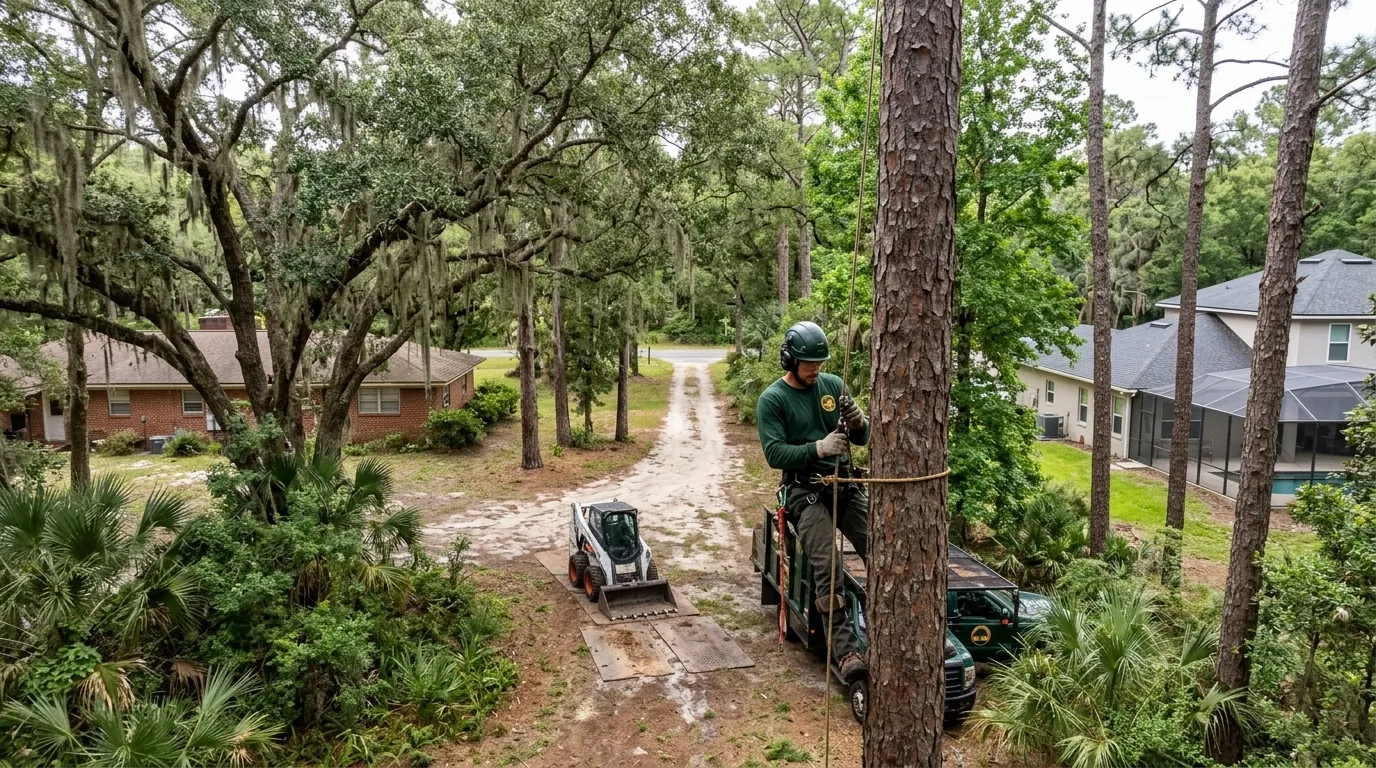
That matters on a job. Before a loaded truck or loader crosses a lawn here, we walk the route and look for low spots, soft sand and any depression that holds water after rain. Ground mats or plywood go down where the soil is loose, and on some acreage lots the smarter plan is to carry wood out by hand or with a small machine instead of backing a big rig across the yard.
Storms reach this hammock too. Hurricane Irma damaged the park's old wooden boardwalk in 2017, and the replacement stairway did not reopen until 2019. Wind that can wreck a staircase in a protected sinkhole can certainly push a top-heavy pine into a roof on Millhopper Road.
Pine Tree Removal in Millhopper's Wooded Lots
Pines are the trees that bring most calls from the western end of Millhopper. Longleaf is the native sandhill pine and tends to hold up well. Loblolly and slash pines grow faster, get tall and thin, and suffer badly in a dry spell, when bark beetles move in. Once the needles fade from green to straw to rust, the tree is usually past saving and the wood dries and turns brittle within months. Our pine tree removal page covers how we take those down, and the warning signs are laid out in our post on pine beetles and dead pines in Alachua County.
What else grows here and how it fails
- Laurel oak. Common in the older subdivisions off NW 43rd Street. Fast growth, then trunk and root rot that often hides behind a healthy-looking crown.
- Live oak. Long-lived and usually worth keeping. The risk is long, heavy limbs over driveways and roofs, which is a pruning or cabling job, not a removal.
- Water oak and sweetgum. Show up along wetter edges and creek-side lots near Possum and Millhopper creeks. Water oaks drop big deadwood as they age.
- Hammock hardwoods. Hickory, southern magnolia and red maple on the shadier lots near the hammock, often crowded and leaning toward the light.
Millhopper Tree Permits Depend on Which Side of the Line You're On
The city limit runs through this part of town in a patchwork, so two houses a few blocks apart can answer to different codes. We look up the parcel on every estimate and tell you which one applies.
| Where the home sits | Code that applies | When a permit comes into play |
|---|---|---|
| Inside City of Gainesville, single-family | City Land Development Code | Heritage trees: most species at 20 in. diameter; laurel oak, water oak, sweetgum, slash and loblolly pine at 30 in. |
| Unincorporated county, single-family, 1 acre or less | Alachua County ULDC | Native trees over 20 in.; laurel and water oaks over 30 in.; specimen trees |
| Unincorporated county, single-family over 1 acre | Alachua County ULDC | Any tree over 8 in. diameter |
| HOA common areas in the county | Alachua County ULDC | Any tree over 8 in. diameter |
That third row surprises a lot of acreage owners on Millhopper Road. Diameter is measured 4.5 feet off the ground in both codes. The county's tree brochure lists a $90 application fee and allows mitigation up to double the normal rate for regulated trees removed without a permit. State law (Florida Statute 163.045) lets a residential owner skip local permits and mitigation when an ISA certified arborist or a Florida licensed landscape architect documents that a tree is an unacceptable risk to people or property. Our post on tree permits in Gainesville walks through the details.
Millhopper Tree Removal Cost: Long Driveways and Tall Pines
Two things move Millhopper prices more than anything else: how far the wood has to travel to the truck, and whether the tree is standing over a house or out in the open. A 70-foot pine with a clear fall zone on an acreage lot can cost less than a 40-foot laurel oak squeezed between two roofs in a cul-de-sac.

| Job | Typical range | What moves the price |
|---|---|---|
| Dead loblolly or slash pine | $600–$2,400 | Height, lean toward the house, and whether it can be felled in one piece |
| Laurel oak in a subdivision yard | $900–$3,200 | Rigging over roofs and fences, trunk decay, haul distance to the street |
| Large tree, no drop zone | $1,800–$3,500+ plus $600–$1,800 crane | Crane setup on a narrow street or soft acreage drive |
| Live oak reduction or cabling | $400–$1,400 | Limb length, number of cables, access for a lift |
| Stump grinding | $95–$450 per stump | Diameter, surface roots, distance from the driveway |
Cleanup and haul-off are part of every removal price. If you want logs left for firewood or chips spread along a back fence line, say so on the estimate and we will price it that way. More on how these numbers are built is in our guide to tree removal cost in Gainesville.
Tree Trimming in Millhopper Before Storm Season
On the subdivision side, the most common trimming work is roof clearance, deadwood removal and lifting low oak limbs over driveways. On the wooded lots it is clearing pine and hardwood limbs back from the house and taking hangers out after a summer storm. Our tree trimming and pruning crew follows the city's guidance of removing no more than a quarter of a crown at once. A split-prone live oak may get a steel cable through our tree cabling and bracing service instead of losing a limb.
Gainesville Regional Utilities serves most of the developed Millhopper area, while Clay Electric covers parts of the county farther out. We confirm which utility owns the line on your property, keep crews clear of any primary wire, and point you to the right company when a limb is resting on it. If a tree does come down, our emergency tree removal line runs around the clock and we photograph the damage for insurance before we cut.
Stump Grinding and Land Clearing on Millhopper Acreage
After a pine removal, most owners here want the stump gone so the yard can be mowed or replanted. Stump grinding takes it 6 to 10 inches below grade, and we can rake the chips into the hole or haul them off. For owners clearing a homesite, a fence line or a pasture edge, land clearing is quoted on site, and on county parcels over an acre we check the 8-inch permit rule before any machine starts.
Tree Service Near Millhopper
Just south and west, the deed-restricted streets of Huntington share Millhopper's 1990s oaks and county rules. Head east toward NW 34th Street and you reach the ranch-house lots of Northwood, inside the city. Farther north up US-441, the town of Alachua has its own tree code and plenty of the same pines.
Millhopper Tree Service Questions
Straight answers before you call.
It depends on the parcel. The city limit runs through northwest Gainesville in an uneven line, so neighbors can fall under different codes, and a Gainesville mailing address does not settle it. We look up the parcel before the estimate and tell you whether the City of Gainesville or Alachua County tree rules apply, and whether any permit is needed for the trees you want removed.
Probably, if the property is in unincorporated Alachua County. The county treats single-family lots over one acre differently and lists a permit requirement for any tree over 8 inches in diameter at 4.5 feet. Dead trees, hazard documentation under Florida Statute 163.045 and the exact tree list all affect the answer, so we check it before we schedule.
We plan around it. Sandy soils over limestone can be soft, so we walk the route first, lay ground mats or plywood where the truck or loader will travel, and avoid low spots that hold water. On some lots we move wood with a small machine or by hand. Any access concern is written into the estimate before work starts.
Usually not. Fast browning from the top in loblolly and slash pines is a classic sign of bark beetles, often after a dry stretch. Once most of the needles fade, the tree dies and the wood gets brittle quickly. We confirm what we see, then remove it before it starts dropping limbs or snaps in a storm.
Yes. On small subdivision lots we climb, cut the tree in sections and lower each piece on ropes into whatever drop zone the yard allows. When there is no safe place to lower wood, we bring in a crane. You get the rigging plan and the fixed price in writing on the estimate.
Yes. Single stump jobs are welcome. We grind 6 to 10 inches below grade, follow surface roots that would trip a mower, and either rake the chips into the hole or haul them away. Pricing depends mostly on diameter and access, and we quote it on site.
Neighborhoods & Towns Near Millhopper
Close by, same crew.
Tree Services in Millhopper
Other work we handle on the same visit.
Tree Removal
Full takedowns, rigged and lowered over whatever is underneath.
Oak Tree Removal
Laurel and water oaks at the end of their life span.
Pine Tree Removal
Dead, beetle-hit, lightning-struck or leaning pines.
Crane Tree Removal
Trees over the house with no safe place to lower wood.
Emergency Tree Removal
Trees on roofs, cars and fences, any hour.
Storm Damage Cleanup
Hangers, split trunks and yard debris after a storm.
Stump Grinding
Ground below grade so you can sod or plant over it.
Land Clearing
Lots, fence lines, invasives and overgrown acreage.
Get a Millhopper Tree Estimate
Tree work in Millhopper? Let’s look at it.