
 Tree on the house?
 Not on the list?
Gainesville neighborhood · 32601
Tree Service in the Duckpond, Gainesville, FL
Century-old houses, deep front porches and oaks that have shaded the same blocks for generations. In the Duckpond we favor pruning and cabling over removal, and when a tree does have to come down, every piece is lowered by rope.
Local snapshot Duckpond
- Original plat
- 1854, the oldest section of the district
- District size
- About 80 blocks between NE 1st and NE 9th Streets, East University Avenue and NE 10th Avenue
- Historic listing
- Local and National Register historic district per city records (1985; expanded 1997)
- Duck Pond
- Built in 1927 to collect water; first named Vidal's Lake
- Tom Petty Park
- 22.5 acres; renamed from Northeast Park in 2018
- Median year built, Census Tract 5
- 1956 (U.S. Census ACS 2020–2024; tract includes the district)
- Distance to downtown
- About half a mile straight-line to Gainesville City Hall
- Sweetwater Branch
- Drops about 125 feet on its way to Paynes Prairie
Landmarks & streets Near our work
- The Duck Pond and Sweetwater BranchThe stone-walled pond and grassy creek banks that give the neighborhood its name; trees here root in damp ground.
- Historic Thomas Center, 302 NE 6th AveA 1928 Mediterranean Revival hotel turned city cultural center, with gardens of live oak and magnolia.
- Tom Petty Park, NE 16th AvenueA 22.5-acre city park just north of the district, reopened in June 2026 after renovation.
- NE 1st StreetThe professional office corridor on the district's west edge, where commercial tree rules apply.
- East University AvenueThe south boundary, with downtown a few blocks beyond.
- NE 9th Street and NE 10th AvenueThe east and north edges of the historic district.
Duckpond Tree Service for One of Gainesville's Oldest Neighborhoods
The Duckpond is the local name for the Northeast Residential Historic District, about 80 blocks between NE 1st and NE 9th Streets from East University Avenue up to NE 10th Avenue. Its original section was platted in 1854, and the houses span Florida styles from the 1880s into the 1950s: frame vernacular homes, bungalows, Colonial Revival and Mediterranean Revival, with later ranch and mid-century infill. City records list it as a local and National Register district since 1985, expanded in 1997. It sits a few blocks from City Hall, at the old core of the city our Gainesville tree service covers.
The neighborhood takes its name from the Duck Pond, built in 1927 to collect water and first called Vidal's Lake after its designer. Sweetwater Branch runs through grassy banks between the streets before heading south through downtown toward Paynes Prairie. The old canopy is part of the district's character, which is why most Duckpond tree work is about keeping old trees safe rather than taking them out.
Tree Trimming in the Duckpond: Pruning Before Removal
For a sense of what this canopy can look like when it is cared for, walk the gardens at the Historic Thomas Center on NE 6th Avenue. The building opened as the Hotel Thomas in 1928 and is now a city cultural center, and its gardens, laid out as part of a rehabilitation that began in 1974, are shaded by big live oaks and southern magnolias. Those trees are the same species shading many Duckpond porches, and they show how long a well-pruned live oak can stay sound in this part of town.
Many Duckpond live oaks and magnolias are older than anyone living under them. The goal with those trees is structure: removing deadwood, shortening limbs that reach far over a roof, and raising the canopy over porches and sidewalks without shearing the crown. We follow the city's own pruning guidance of taking no more than 25 percent of a crown at a time. Our tree trimming and pruning service is built around that kind of light, repeated work.
Where a heavy limb or a split-prone fork still has years left in it, a steel cable or a through-bolt can hold it together. Tree cabling and bracing is often the reason an old Duckpond oak survives another hurricane season, and it costs far less than a large removal over a historic roof.
Old houses change the rigging
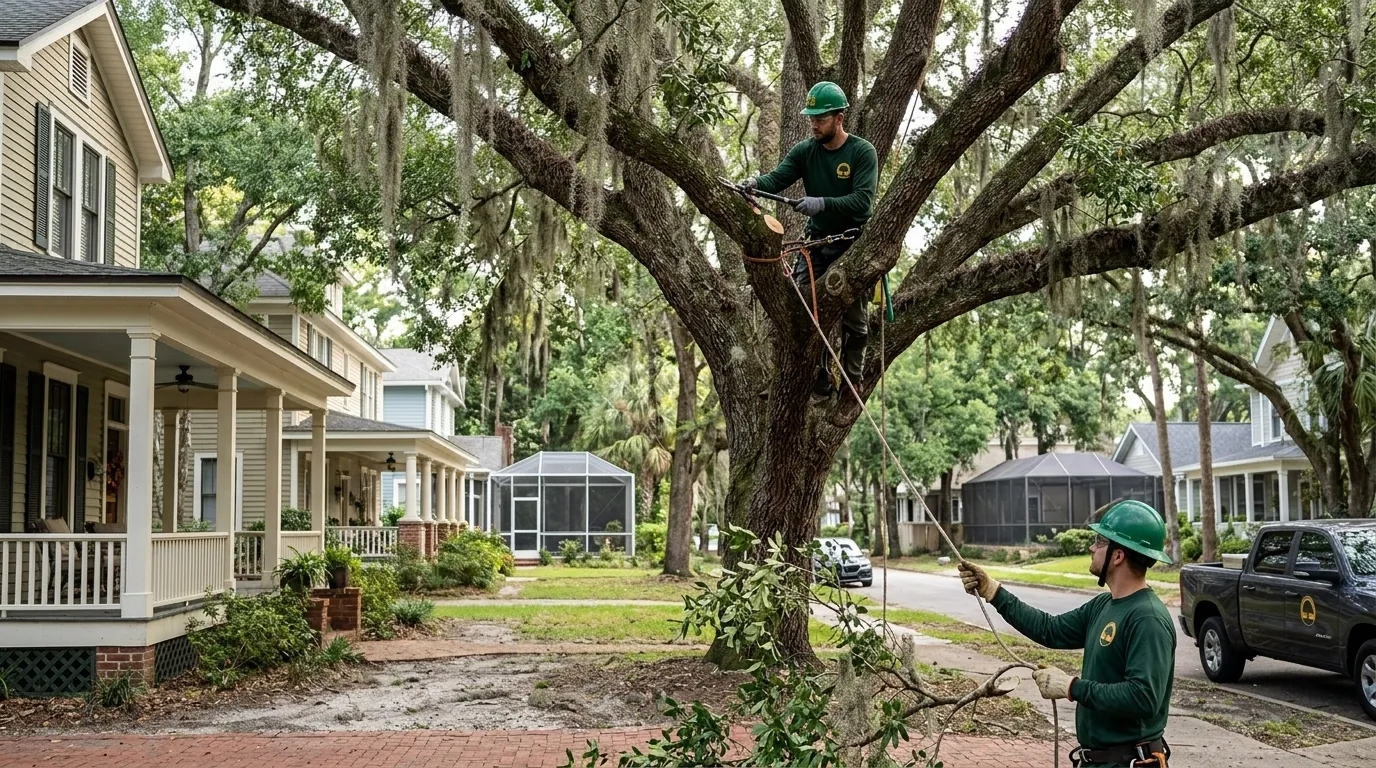
Wood-frame houses, porches, chimneys and original windows all sit within reach of these canopies. Nothing is free-dropped here. Limbs are tied off and lowered on ropes through the crown, and we lay plywood over lawns and walkways before a loader or grinder moves across them.
Duckpond Tree Removal and Historic District Rules
The Duckpond sits inside the City of Gainesville, so the city's tree code applies. For an existing single-family home, only heritage trees need a permit: most species at 20 inches in diameter, and laurel oak, water oak, sweetgum, slash pine and loblolly pine at 30 inches. Live oak and southern magnolia are on the city's High Quality list and are regulated anywhere on the lot once they reach heritage size.
Two things make the Duckpond different from a typical city neighborhood:
- Mixed land uses. The district includes multi-family buildings and a professional office corridor along NE 1st Street. On any property that is not a detached single-family home, the city regulates living trees from 8 inches in diameter.
- Historic district review. Changes to properties in a local historic district can require a Certificate of Appropriateness from the city's historic preservation staff. We ask the city's planners whether anything beyond a tree permit applies to your property before work is scheduled.
Florida Statute 163.045 still applies to residential property here: with written documentation from an ISA certified arborist or a Florida licensed landscape architect that a tree is an unacceptable risk, the city cannot require a permit, fee or mitigation for removing it. Our article on tree permits in Gainesville covers the process. When removal is the right answer, our oak tree removal crew takes the tree down in small, controlled pieces.
Oak Tree Removal Along Sweetwater Branch
Not every big Duckpond tree is a live oak. Water oaks and laurel oaks fill in a lot of the canopy, especially along the damp ground near Sweetwater Branch and the pond. Water oaks shed heavy deadwood as they age and often decay at the root flare. Laurel oaks look healthy for years while rot hollows the trunk. Along the creek, invasive air potato vine and other weedy growth can climb into small trees and hide the trunk, so we clear enough to inspect the base before giving a recommendation.
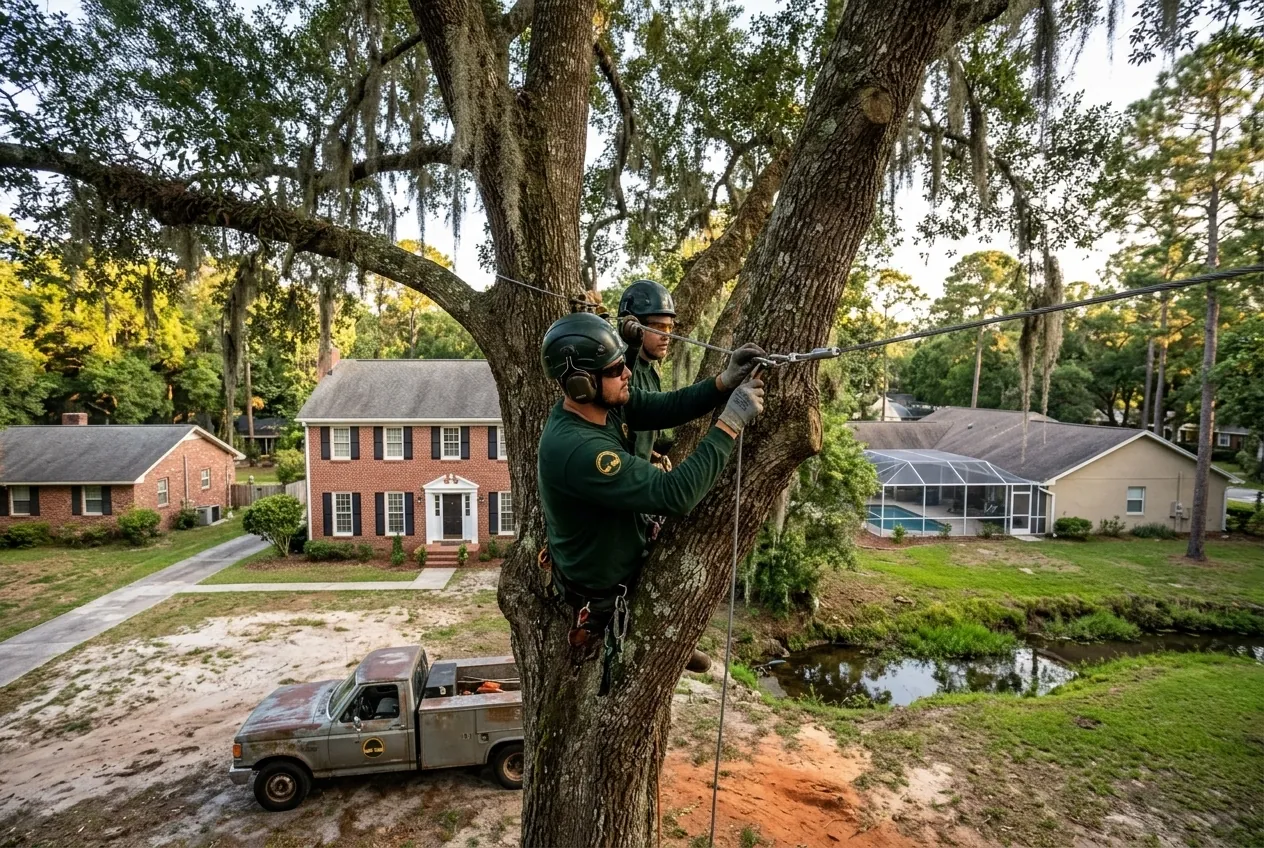
Water oaks that do need to come out here are often among the largest trees on the block, with trunks that reach well past the city's 30-inch heritage size. That means a permit question, a rigging plan and, on narrow lots, sometimes a crane. We price all three on the estimate so nothing changes once work starts. A healthy magnolia or live oak next to it may only need a trim to recover the light the oak was blocking.
Duckpond Tree Service Pricing
Duckpond jobs usually cost more per foot of tree than the same work in a newer subdivision. Lots are narrow, houses sit close together, parking for a chipper is limited on some blocks, and almost everything is lowered by hand. The trade-off is that much of the work here is pruning and cabling, which costs less than a removal.
| Job | Typical range | What moves the price |
|---|---|---|
| Structural pruning of a mature live oak | $400–$1,400 | Crown spread, number of limbs over the house, porch and roof protection |
| Cabling and bracing | $350–$1,200 per tree | Number of cables or bolts and climbing height |
| Laurel or water oak removal | $850–$3,200 | Rigging over historic roofs, narrow side yards, haul-out distance |
| Crane-assisted removal | Add $600–$1,800 | Street width, overhead lines and where the crane can set up |
| Magnolia crown raise | $250–$800 | Height of the raise and clearance over the walk or porch |
All prices are written and fixed before the work. For more on what goes into a quote, read how much tree removal costs in Gainesville.
Emergency Tree Removal, GRU Lines and Street Trees in the Duckpond
The neighborhood is on Gainesville Regional Utilities, and older streets carry overhead lines through the canopy. Trees touching primary lines are GRU's to clear. Trees growing in the public right-of-way belong to the city; for a fallen tree in the road or on a utility line, the city directs residents to Public Works. On the private side, we handle hangers, split limbs and trees on structures, and our emergency tree removal line is open around the clock. Our post on what to do when a storm drops a tree walks through the first few hours.
Tree Care Around the Duckpond
A few miles northeast near Waldo Road, Ironwood has newer homes along a city golf course. Across downtown to the west, University Park and Florida Park have the postwar homes and big oaks of the neighborhoods north of UF.
Duckpond Tree Care Questions
Straight answers before you call.
The tree itself goes through the city's tree permit rules: heritage-size trees on single-family lots, and trees from 8 inches on other land uses. Because the Duckpond is a local historic district, some property changes also need a Certificate of Appropriateness. We check with the city's historic preservation staff for your address before scheduling.
Yes. We prune for structure, not looks: deadwood out, long limbs shortened back to good lateral branches, clearance over the roof and porch. We stay within the city's guidance of removing no more than a quarter of the crown at once. Heavy limbs that are worth keeping may get a cable instead of a cut.
Probably not. Trees in the public right-of-way are generally the city's to manage, and the city directs fallen trees in the road or on lines to Public Works. If the trunk is on your side of the property line, it is yours. We look at the survey or property records with you if it is unclear.
Every limb is tied off and lowered on rigging, never dropped. We set the lowering path away from the roof and porch, lay plywood across lawns and brick walks, and use a crane when there is no safe way to lower wood. The plan is written into your estimate.
Trees in damp ground root shallower, and water oaks and laurel oaks along wet edges are prone to root and base decay. That does not make every creek-side tree a hazard. We inspect the root flare and lean, clear vines away from the trunk, and give you an honest read on whether it needs work.
Yes. Keep in mind that the city regulates living trees from 8 inches in diameter on any property that is not a detached single-family home, so offices on NE 1st Street and multi-family buildings usually need a permit for removals. We include that step in the estimate.
Tree Services in Duckpond
Other work we handle on the same visit.
Tree Removal
Full takedowns, rigged and lowered over whatever is underneath.
Oak Tree Removal
Laurel and water oaks at the end of their life span.
Pine Tree Removal
Dead, beetle-hit, lightning-struck or leaning pines.
Crane Tree Removal
Trees over the house with no safe place to lower wood.
Emergency Tree Removal
Trees on roofs, cars and fences, any hour.
Storm Damage Cleanup
Hangers, split trunks and yard debris after a storm.
Stump Grinding
Ground below grade so you can sod or plant over it.
Land Clearing
Lots, fence lines, invasives and overgrown acreage.
Get a Duckpond Tree Estimate
Tree work in Duckpond? Let’s look at it.