
 Tree on the house?
 Not on the list?
Gainesville neighborhood · 32653
Tree Service in Mile Run, Gainesville, FL
Mile Run's homes went up in phases from the mid-1980s through the late 1990s, and the oaks planted with them are now at the age where they need real attention. We work here with the City of Gainesville rules and your phase's association in mind.
Local snapshot Mile Run
- Homes built
- Mid-1980s to late 1990s (listing records show 1984 to 1999)
- Median year homes built, census tract 18.03
- 1983 (ACS 2020–2024 5-year)
- Owner-occupied homes, ZIP 32653
- 5,425 of 6,505 (about 83%; ACS 2020–2024)
- ZIP 32653 population
- 15,150 (ACS 2020–2024 5-year)
- Possum Creek Park
- 76 acres, at 4009 NW 53rd Ave
- Possum Creek watershed
- About 8 square miles; the largest tributary of Hogtown Creek
- To downtown Gainesville
- About 4.8 miles straight-line to City Hall
Landmarks & streets Near our work
- Possum Creek Park76-acre city park on NW 53rd Ave at Mile Run's south edge, with hardwood hammock that drops limbs and leaves onto neighboring lots.
- NW 53rd AvenueThe main road along the south side; most Mile Run streets feed into it.
- NW 43rd StreetWest-side route to the Hunters Crossing shops and the turn onto NW 53rd Ave.
- Hunters Crossing shopping centerAbout a mile away; the closest shopping and a busy intersection for truck traffic.
- William S. Talbot Elementary5701 NW 43rd St; morning and afternoon school traffic changes when we can stage.
- Possum CreekRuns 6.5 miles south to Hogtown Creek through hammock and neighborhoods; nearby low spots stay wet.
Mile Run Tree Service for 1980s and 1990s Lots
Mile Run sits in northwest Gainesville north of NW 53rd Avenue and east of NW 43rd Street, with streets like NW 37th Terrace and NW 54th Lane. It was built in many phases, with names like Mile Run East Phase II and Phase V, and home build years in listing records run from 1984 into 1999. The mix includes detached houses, attached homes and townhouses, and listings mention a community pool, tennis and pickleball courts and walking trails.
For trees, the build years tell the story. Laurel oaks, water oaks and sweetgums planted in the late 1980s are 35 to 40 years old now. Laurel oaks in particular tend to start rotting inside right around this age, and many in Mile Run were planted close to the houses.
Mile Run Tree Removal and Your Phase's HOA
This is the first thing to sort out in Mile Run. Each phase has its own association and its own dues, and what they cover varies a lot. At least one phase's association covers exterior maintenance including roofs, while others only handle common areas. Before you call anyone, check:
- Whether the tree is on your lot, a shared yard, or common ground.
- Whether your association's maintenance covers landscaping and trees, or only buildings.
- Whether a removal or a big trim needs approval from the board.
- Whether a neighbor in an attached unit shares the yard or the roof the tree hangs over.
If the association handles it, we're happy to quote the board directly. If it's yours, we'll give you the written estimate.
City of Gainesville Tree Rules in Mile Run
Mile Run is inside Gainesville city limits, so the city's land development code applies, not the county's. On a detached single-family lot, only Heritage Trees are regulated. Most species become Heritage Trees above 20 inches in diameter, but water oaks, laurel oaks, sweetgums and slash and loblolly pines don't qualify until 30 inches. High Quality species like live oak, southern magnolia and longleaf pine are regulated anywhere on the lot, while other Heritage Trees are regulated only in the legal setback. There's no city application fee.
One detail matters more in Mile Run than in most neighborhoods. The city notes that in a planned development, a tree may be regulated at any size if it's part of the development's approved landscape plan, such as trees along the street or in parking areas. If your Mile Run tree looks like it went in with the original streetscape or a common planting strip, we ask the city or apply for a removal permit to be safe. Our post on tree permits in Gainesville, FL covers the basics, and Florida Statute 163.045 still lets you skip the permit for a home-lot tree documented as an unacceptable risk by a certified arborist or licensed landscape architect.
Oak Tree Removal Next to Mile Run Homes
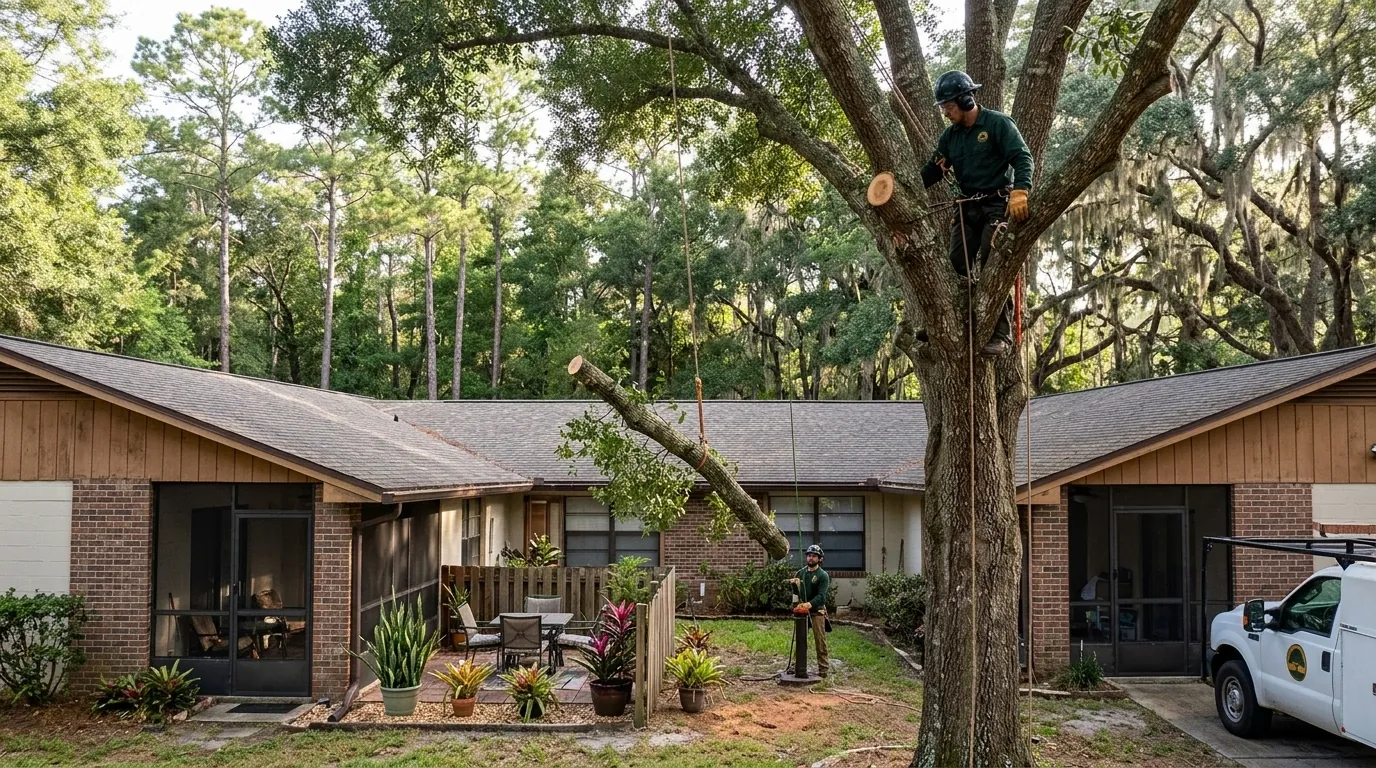
Attached homes and tight side yards mean most oak work here is done by climbing and rigging, not felling. Limbs come down in short sections on ropes and are lowered away from roofs, screened porches and fences. When an oak sits between two attached units, both owners usually need to be part of the plan. Our oak tree removal page walks through how we handle that, and the article on why laurel oaks fail explains the decay we look for.
Mile Run Tree Trimming for Roofs and Gutters
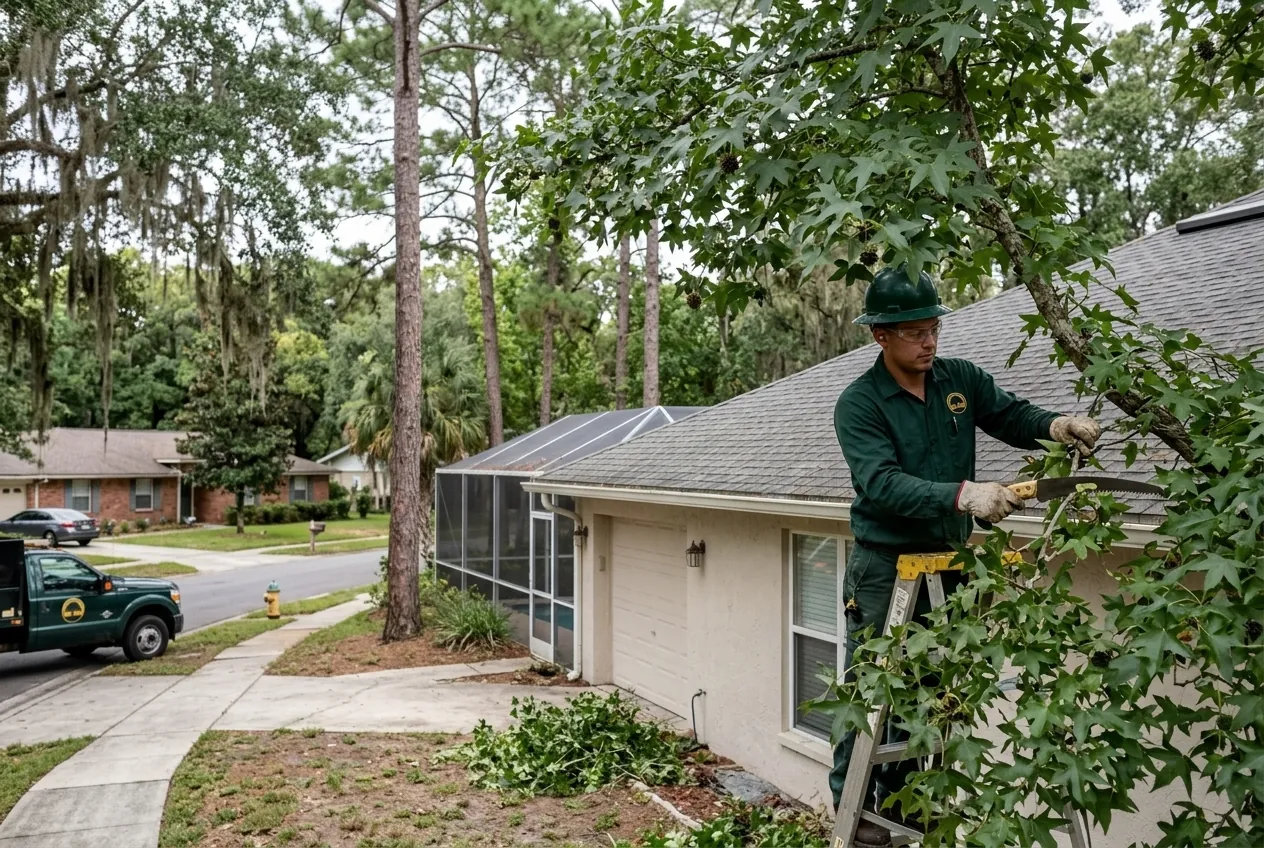
Some Mile Run homes have oaks or sweetgums planted close enough that limbs now rest on the roof or hang over the gutters. That causes three problems. Leaves pack the gutters, branches scrape shingles in every breeze, and squirrels get an easy path into the attic. Clearing limbs 6 to 10 feet back from the roof fixes most of it without hurting the tree.
On attached homes, we trim for both units at once when owners agree, so one side isn't left with branches on the shared roof. Sweetgum gumballs are another common complaint here; thinning and raising the canopy won't stop them, but it can keep them off the patio. Our tree trimming and pruning service covers this kind of work, priced per tree.
Cabling instead of removal
Not every big oak between two Mile Run homes has to come out. If the trunk is solid but the tree has a tight fork or a heavy limb leaning over a shared roof, a steel cable can hold it together and buy years. Tree cabling and bracing costs $350 to $1,200 per tree, usually far less than a rigged removal, and it keeps the shade both units depend on in summer.
Mile Run Tree Removal Costs
Prices in Mile Run lean on rigging time more than tree height. A 40-foot laurel oak that has to come down in pieces between two attached homes can cost more than a taller pine in an open backyard.
| Job | Typical range | What moves the price |
|---|---|---|
| Laurel oak removal between homes | $900–$3,200 | Rigging, shared roofs, how many sections |
| Sweetgum removal | $450–$1,600 | Size, surface roots, gumball cleanup |
| Deadwood and roof clearance trim | $175–$900 per tree | How much comes out, access from the front |
| Cabling a split-prone fork | $350–$1,200 | Height of the fork, hardware needed |
| Stump grinding | $95–$450 per stump | Root spread near sidewalks and slabs |
If you're not sure whether a Mile Run tree needs work at all, ask for a tree health check with your estimate. We look at the base and root flare, sound the lower trunk, check the main fork for cracks or included bark, and scan the crown for dead or hanging limbs. You get a plain answer: leave it, trim it, cable it or remove it. Written hazard notes are available on request, which helps if your association wants something in the file before approving a removal.
Mile Run Stump Grinding Near Slabs and Sidewalks
Older oaks in Mile Run often sit within a few feet of a slab, a sidewalk or a patio. When one comes down, the stump and its big surface roots are right against the concrete. We grind the stump and the largest roots close to the pavement with a smaller machine, which helps stop the roots from rotting under the edge and leaving a void. Expect this to land in the $95 to $450 range per stump, depending on size.
Hunters Crossing traffic and the school zone at Talbot Elementary make midday the easiest time to bring in a grinder, and we plan our arrival around that.
Mile Run Storm Damage Cleanup Near Possum Creek
Possum Creek Park borders Mile Run's south side with 76 acres of fields, trails and hardwood hammock. The creek itself is the largest tributary of Hogtown Creek and runs through wetlands and woods, so lots near it stay damp and oaks there root shallow. In a hard summer storm, it's often limbs from the park edge or older yard oaks that come down on fences. If a tree is touching a service drop, call GRU before anyone climbs. For trees on houses, our emergency tree removal crew answers 24/7, and storm damage cleanup handles hangers and debris afterward.
Tree Service Near Mile Run
Close by are Huntington and Millhopper, both with similar-aged oaks, and Northwood a short drive east. For anything else in town, see our tree service across Gainesville.
Mile Run Tree Removal FAQ
Straight answers before you call.
Yes. Census boundary files place Mile Run inside the City of Gainesville, so the city's tree code applies. On a detached single-family lot, only Heritage Trees are regulated, and there's no city permit fee. Some planned-development landscape trees can be regulated at any size.
It depends on your phase. Mile Run has several associations with different dues and coverage, and some include exterior maintenance while others only cover common areas. Check your documents or ask the board. We can quote either you or the association.
It might be. Laurel oaks in Mile Run are roughly 35 to 40 years old, which is when many start to decay at the base or at old pruning cuts. We sound the trunk and look for fungus before suggesting removal, and if it's sound we'll say so.
Yes. We climb the tree and lower it in sections on ropes, away from both roofs. Because the tree affects two properties, we suggest both owners agree on the plan, and the association may need to sign off too. Cleanup on both sides is included in the price.
On a detached single-family lot, a sweetgum isn't a Heritage Tree until it passes 30 inches in diameter at 4.5 feet, so most don't need a permit. If it was planted as part of an approved landscape plan along a street or common area, it may be regulated, and we'll check.
Neighborhoods & Towns Near Mile Run
Close by, same crew.
Tree Services in Mile Run
Other work we handle on the same visit.
Tree Removal
Full takedowns, rigged and lowered over whatever is underneath.
Oak Tree Removal
Laurel and water oaks at the end of their life span.
Pine Tree Removal
Dead, beetle-hit, lightning-struck or leaning pines.
Crane Tree Removal
Trees over the house with no safe place to lower wood.
Emergency Tree Removal
Trees on roofs, cars and fences, any hour.
Storm Damage Cleanup
Hangers, split trunks and yard debris after a storm.
Stump Grinding
Ground below grade so you can sod or plant over it.
Land Clearing
Lots, fence lines, invasives and overgrown acreage.
Get a Fixed Price for Your Mile Run Tree
Tree work in Mile Run? Let’s look at it.