
 Tree on the house?
 Not on the list?
Lots & acreage · Alachua County, FL
Land Clearing in Gainesville & Alachua County, FL
Overgrown lots, buried fence lines and woods full of camphor, Chinese tallow and air potato, cleared selectively so the trees worth keeping stay. Permits, burrows and wet ground are checked before any machine moves.
Land Clearing in Alachua County, From Fence Lines to Full Lots
Clearing jobs around here run from a strip along a back fence that vines and volunteer trees have taken over, to a wooded lot where someone plans to build, to a few acres of pasture edge that has filled in with camphor and tallow. Each one is priced on site, because the density of what is growing matters more than the acreage on paper.
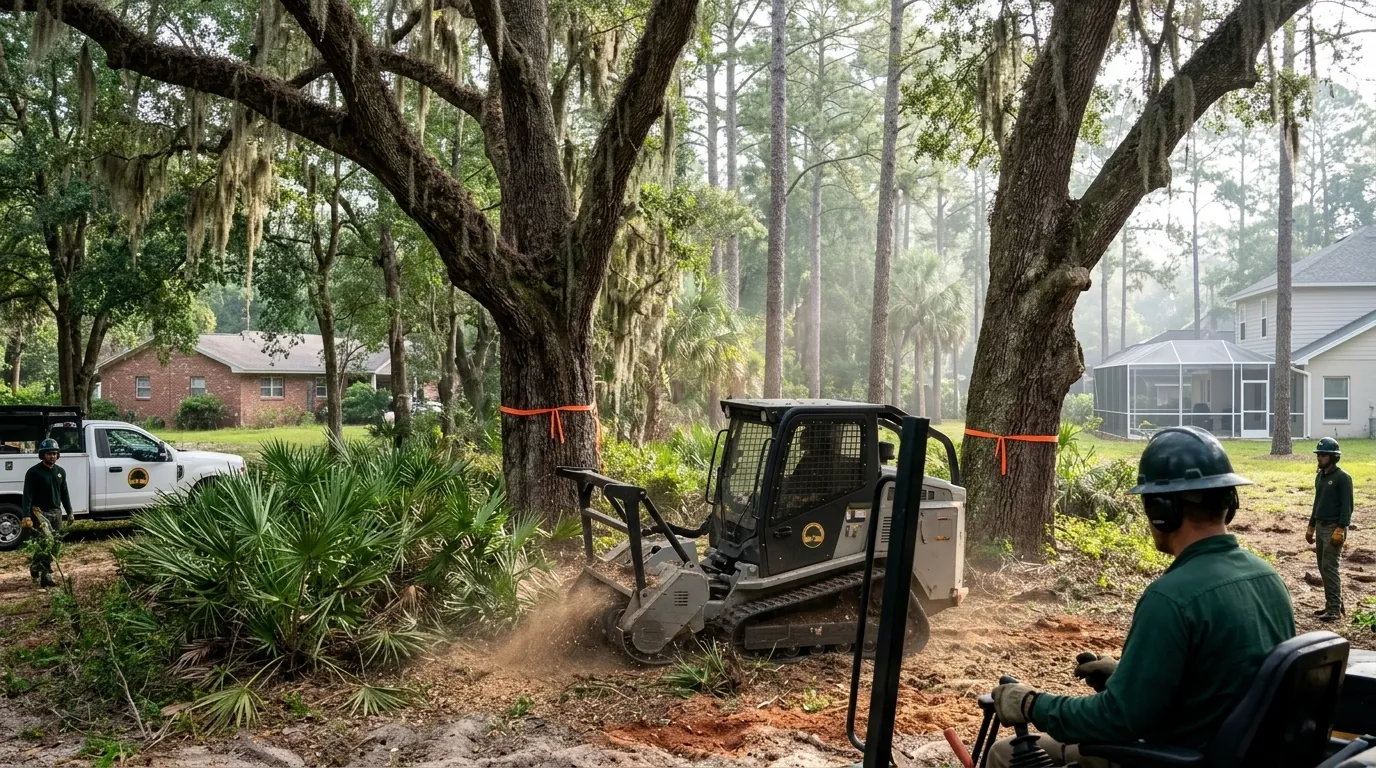
Clearing is selective by default. That means marking the trees worth keeping, such as a healthy live oak, a longleaf pine or a southern magnolia, and working around them while the underbrush, invasives and dead or badly formed trees come out. A lot with mature shade left standing is cooler, more pleasant and usually worth more than a bare one, and in much of the county, keeping large native trees is also what the tree code expects.
Typical clearing jobs
- Fence line clearing: vines, saplings and overhanging limbs cut back so a new fence can go in or an old one can be repaired
- Underbrush clearing: thick understory taken out while the larger trees stay
- Homesite and driveway clearing on a wooded lot, staked to your plans
- Invasive removal: camphor, Chinese tallow, air potato and similar species
- Broken and leaning timber cut up and removed from storm-hit woods
- Mulching, chipping and hauling, so nothing is left behind in piles
Gainesville Land Clearing Costs per Acre
Light land clearing in Gainesville and Alachua County typically runs $1,800 to $6,500 or more per acre. Light means mostly brush and small trees with good access. Dense hardwood stands, big trees that have to be felled and hauled, and heavy invasive cover are quoted on site after a walk of the property with you.
| Job | Typical range | What moves the price |
|---|---|---|
| Light brush clearing, per acre | $1,800 – $3,500 | Brush height, open access for the mulcher |
| Brush with scattered small trees, per acre | $3,500 – $6,500+ | Tree count and diameter, soft or uneven ground |
| Dense or wooded acreage | Quoted on site | Large trees, haul-off volume, stumps |
| Fence line clearing | Quoted by length | Vine load, trees on the line, neighbor access |
| Selective invasive removal | Quoted on site | Number of camphor and tallow trees, follow-up visits |
| Stump grinding after clearing | $95 – $450 per stump | How many stumps and how large |
Mulching in place is usually the most economical approach on acreage, since the material stays on site as ground cover instead of being trucked away. A homesite where a builder needs bare ground costs more, because logs and debris are hauled off and stumps are ground. If you only need a handful of large trees out of an otherwise open yard, that is really a tree removal job, and pricing it that way is usually cheaper.
Lot Clearing Rules in Gainesville and Alachua County
Clearing is regulated more closely than trimming or a single removal. In unincorporated Alachua County, the county's tree permitting rules say that on single-family lots larger than an acre, and on commercial, multifamily and homeowners association property, any tree over 8 inches in diameter needs a permit before it comes out. That covers most woods worth clearing. Mitigation planting or a fee in lieu can be required, and the county forester reviews the requests.
Inside the City of Gainesville, the Urban Forestry program requires a permit to remove living trees 8 inches or more in diameter on land other than detached single-family homes. Those permits are free, but they must be in hand before work begins. The towns have their own codes, so clearing in Newberry, Archer, Alachua or Hawthorne follows that town's rules rather than the county's. The jurisdiction for every parcel is checked before we quote, and you will know what approval is needed. Florida Statute 163.045, which lets homeowners remove a documented dangerous tree without a permit, covers individual hazard trees on single-family home lots; it is not a general exemption for clearing land.
Clearing Invasive Camphor, Chinese Tallow and Air Potato
Three invasive plants are worth singling out. Camphor, which UF/IFAS lists as invasive in North and Central Florida, can reach about 70 feet, produces heavy crops of shiny black berries and spreads wherever birds carry the seed. Chinese tallow, also called popcorn tree, is on Florida's noxious weed list. A large tallow can produce up to 100,000 seeds, carried off by birds and water, and cut trees resprout from their roots.
Air potato is the vine that blankets fence lines and climbs into tree canopies, shading out whatever it covers. It is also on the state noxious weed list, and it spreads by the potato-like bulbils that drop from the vines. Gainesville took it seriously enough to hold a Great Air Potato Roundup for years starting in 2000, and the air potato leaf beetle, first released in Florida in 2012 through UF/IFAS and its partners, now helps knock it back. Pulling vines off trees and collecting bulbils by hand is still part of any thorough cleanup.
Timing matters with tallow. UF/IFAS-linked guidance advises against cutting or treating tallow during its seed season, roughly August into early September, because the work can spread viable seed. Invasive jobs are planned around that window, and a follow-up visit or two is recommended, since stump sprouts and new seedlings are normal for a season after the first cut. Our stump grinding service takes care of the stumps, but sprouts still need attention.

Land Clearing Around Gopher Tortoises, Wetlands and Sinkholes
Gopher tortoises live in parts of every Florida county and favor dry, sandy ground like much of the upland in Alachua County. They are a state-designated threatened species, and both the tortoise and its burrow are protected. Under Florida Fish and Wildlife Conservation Commission rules, a permit is needed before land clearing that comes within 25 feet of a potentially occupied burrow. The simplest route is to keep all work at least 25 feet from every burrow, in every direction. When that is not possible, the landowner needs an FWC permit and an authorized agent to relocate the tortoises first, so we look for burrows on the walk-through.
Water and karst add their own limits. Alachua County regulates wetlands, surface waters and their upland buffers, along with significant geological features, and those rules can restrict clearing near a creek, pond or sinkhole. The county sits on limestone, with the sinkhole at Devil's Millhopper as the best-known reminder, and heavy machines do not belong on the rim of a depression. If a parcel has any of these features, they are flagged on the quote along with a suggestion to check with the county before work is scheduled.
How Alachua County Land Clearing Works on Site
A typical job starts with a walk-through. Keeper trees are flagged with ribbon, property lines and any burrows or wet spots are marked, and we agree on exactly where the cleared edge stops. On larger tracts, a forestry mulcher grinds brush and small trees into a mat of chips that protects the soil from washing out. Bigger trees are felled, cut up and hauled or chipped. Stumps are ground wherever the ground needs to be smooth for building, mowing or sod.
Nothing gets burned. Open burning depends on Florida Forest Service rules and local conditions; piles more than 8 feet across need a Forest Service authorization, and Alachua County declared a mandatory countywide burn ban in March 2026 during dry weather. Chipping and hauling sidesteps all of that and leaves no ash pile for the neighbors to smell.
Ground protection matters too. On a homesite where the rest of the yard is already in sod, mats go down wherever the machines travel. In wet months, low parcels can stay soft for weeks, and clearing is scheduled around that rather than rutting the site.
We clear land across the county, from rural parcels near High Springs and Waldo to infill lots inside the city. Call or text us, or send the parcel address and a few photos through the estimate form. For trees closer to the house, the rest of our tree service across Gainesville covers trimming, removal and cleanup.
Land Clearing Alachua County Questions
Straight answers before you call.
Light clearing of brush and small trees typically runs $1,800 to $6,500 or more per acre, depending on density and access. Heavily wooded land, big trees that must be hauled, and thick invasive cover are quoted on site after a walk-through. Mulching material in place usually costs less than hauling it all away.
Often, yes. In the unincorporated county, trees over 8 inches in diameter need a permit on single-family lots larger than an acre and on commercial, multifamily and association property. The City of Gainesville and each town have their own rules. The jurisdiction is checked before quoting, and you will know which approval to get.
Yes, and that is the default approach. The trees you want to keep, such as live oaks, longleaf pines and magnolias, are flagged first, and the underbrush, vines, invasive trees and dead wood around them come out. Selective clearing keeps shade and value on the lot and keeps the work in line with the local tree code.
Burrows are located during the walk-through, and all work stays at least 25 feet away from them whenever possible, which is the FWC standard for avoiding a permit. If clearing has to happen closer, the landowner needs an FWC relocation permit and an authorized agent to move the tortoises before work there can start.
The vines are pulled out of trees and fences, cut at the base, and as many of the aerial bulbils as practical are collected, since each one can start a new vine. Follow-up is needed because underground tubers and missed bulbils resprout. The air potato leaf beetle, released in Florida as a biological control, also feeds on the vines and helps keep them down.
No. Material is mulched on site or chipped and hauled away. Burning depends on Florida Forest Service authorization and on county burn bans, which can be declared during dry spells, and it puts smoke and ash near the neighbors. Mulch also protects bare soil from erosion while new grass or plantings take hold.
More Gainesville Tree Services
Other work we handle on the same visit.
Tree Removal
Full takedowns, rigged and lowered over whatever is underneath.
Oak Tree Removal
Laurel and water oaks at the end of their life span.
Pine Tree Removal
Dead, beetle-hit, lightning-struck or leaning pines.
Crane Tree Removal
Trees over the house with no safe place to lower wood.
Emergency Tree Removal
Trees on roofs, cars and fences, any hour.
Storm Damage Cleanup
Hangers, split trunks and yard debris after a storm.
Stump Grinding
Ground below grade so you can sod or plant over it.
Tree Trimming & Pruning
Roof clearance, deadwood out and crown raising without topping.
Land Clearing Across Alachua County
Send the parcel address and what you want cleared. We will walk it, flag the keepers and quote it in writing.