
 Tree on the house?
 Not on the list?
24/7 storm line · Gainesville & Alachua County
Emergency Tree Removal in Gainesville, FL
A tree through the roof, across the only driveway, or pinning a car does not wait for office hours. We answer around the clock, document the damage for your claim, and get the weight off the house first.
Emergency Tree Removal Gainesville Residents Can Reach at 2 a.m.
An emergency, the way we use the word, means a tree or a big limb is on something that matters and leaving it there makes things worse. That is a trunk on a roof, a tree across the only way out of the driveway, a limb pinning a car, or a split tree hanging over a bedroom. Those calls get a crew at any hour. A tree that fell across the back lawn and touched nothing can wait for daylight, and we will tell you so honestly, because the after-hours rate only makes sense when there is real risk.
Storm cleanup that follows a few days later, such as hanging limbs, split trees still standing, and piles of debris, has its own page on storm damage cleanup. This page is about the first hours.
Tree on the House: What to Do Before the Crew Arrives
- Get everyone out of the rooms under the impact, and out of the house if you hear cracking or see the ceiling sag.
- Stay away from any wire on the ground or in the tree. Treat every downed line as live, and report it to your electric utility before anything else.
- If water is coming in, shut off power to that part of the house at the breaker panel only if you can reach it without standing in water.
- Take your own photos and video from a safe distance, wide shots first, then close-ups of where the tree meets the roof.
- Call your insurance company to open a claim, then call or text us through the storm line.
Emergency Tree Service in Gainesville: How the First Hours Go
When we arrive, the first job is not cutting. It is looking. The crew checks for lines in the tree, reads how the trunk is loaded on the structure, and decides whether the tree can be pieced off with rigging from above or needs to be lifted. Before any saw starts, we photograph the tree, the point of contact, the roof from the ground, and the root plate or break so your adjuster has a clear record of what fell and why.
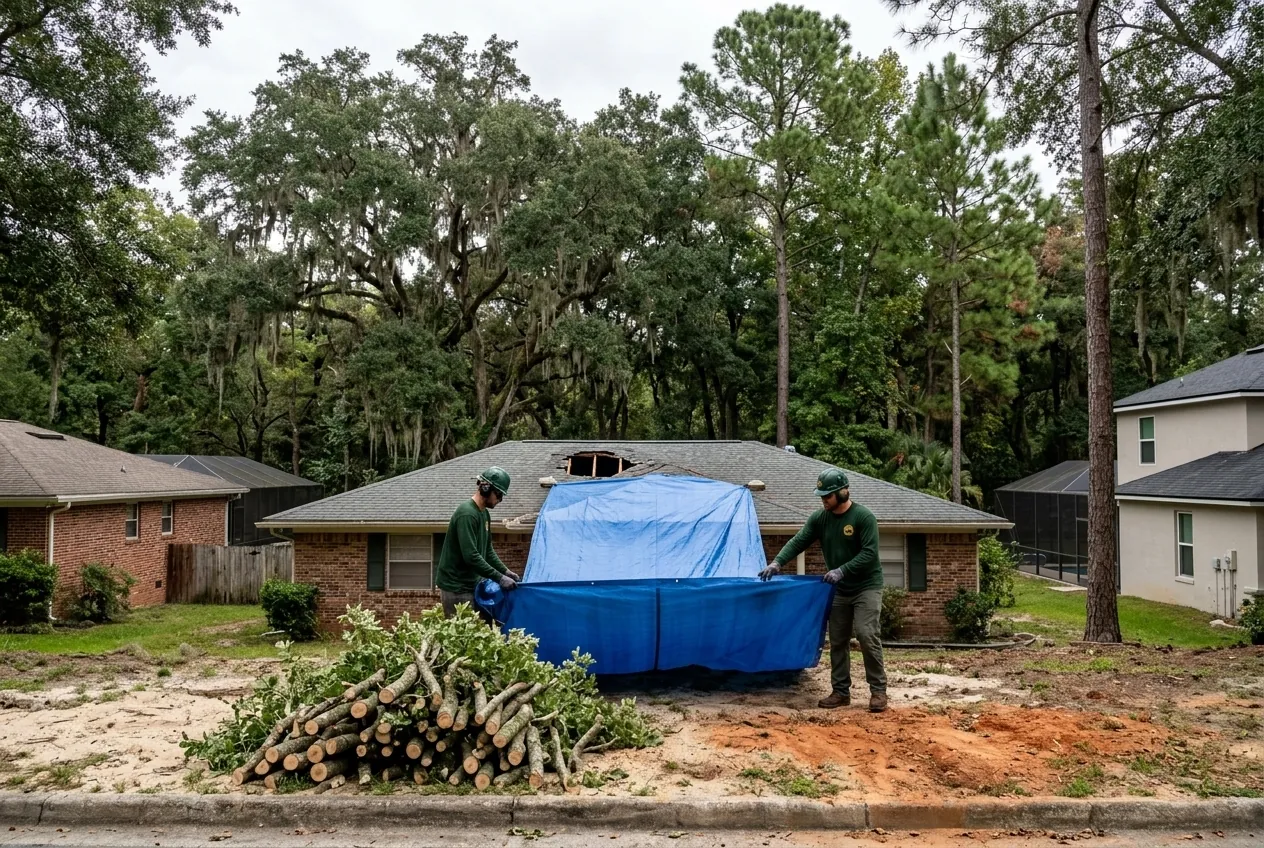
Then the weight comes off in the order that keeps the structure safest. Small limbs on top go first so the climber can see what is holding what. Where a trunk is spanning the roof, a crane often picks it straight up rather than rolling it across the shingles. Our crane tree removal page covers that setup in more detail. Once the roof is clear, we can put a tarp over the opening to keep rain out until a roofer arrives.

Working safely in the dark
Night work runs under portable lights and at a slower pace than a daytime removal. The crew does only what is needed to make the house safe: take weight off the roof, cut back anything still hanging over a doorway or bedroom, and tarp the opening. Climbing a storm-twisted tree at midnight, with wind still gusting, is a risk we take only when leaving it in place is the bigger danger. If it is safer to wait for first light, we will tell you, set up what we can from the ground, and come back at daybreak.
That judgment is also why a phone call matters more than a web form during a storm. Describe what the tree is resting on, whether anyone is inside, and whether any wires are involved. Those three answers decide which crew goes where first.
Trees on cars, fences and driveways
A tree on a vehicle is handled the same way: photos first, then the load is cut so it lifts off rather than drops. Blocked driveways get a lane cut so you can get out, and the rest of the tree can be finished on a normal-rate day if you prefer. Fence damage is documented and the debris cleared, though repair is a job for a fence contractor.
Emergency Tree Removal Cost in Gainesville
Emergency pricing starts from the same size ranges as any removal, then adds a premium for nights, weekends and active storm days. That premium pays for crews working through the dark and for equipment held ready during hurricane season. The written price is still agreed before the main work starts, though on a true emergency we may do a short make-safe step first and price the rest once the tree is stable.
| Job | Typical range | What moves the price |
|---|---|---|
| Limb off a car, fence or carport | $350–$850 + after-hours add | Limb size and whether it is under tension |
| Medium tree on a roof, rigged off | $850–$1,800 + after-hours add | Roof pitch, number of contact points, access |
| Large tree on a structure | $1,800–$3,500+ + after-hours add | Trunk weight, decay, how far wood must be carried |
| Crane lift for a tree on a roof | +$600–$1,800 | Crane size, setup distance, debris on the street |
| After-hours or storm-day premium | +25–50% | Time of call and whether storms are still active |
| Driveway lane cut only | Quoted on site | Trunk diameter and how much needs to move |
Insurance coverage depends on your policy and on what the tree hit. A tree that lands on the house or another covered structure is commonly part of a claim, along with the cost of removing it from that structure. Read what to do when a storm drops a tree in Gainesville for the paperwork side, and keep every invoice and photo we send you.
Storm Emergencies Around Gainesville: What Recent Hurricanes Showed
Hurricanes reach inland here more often than people new to Gainesville expect. When Irma came through in September 2017, WUFT reported that more than 30,000 GRU customers were without power by the next morning, much of it from trees and limbs on lines. Idalia in August 2023 was milder for the city, but Clay Electric reported thousands of outages that day, mostly on the west side of the county. Helene in September 2024 was described by local officials as a countywide event, with widespread trees and lines down.
The pattern in those storms is consistent. Older laurel and water oaks with hidden decay, and pines already weakened by beetles or lightning, are the trees that fail first. That is why a pre-season look at the trees closest to the house is worth the time. A tree health check or some targeted pruning before hurricane season costs far less than a night call.
Downed Trees and Power Lines in Gainesville and Alachua County
A tree on a line is first a utility problem and only then a tree problem. Inside much of the city that utility is Gainesville Regional Utilities. Large parts of the county, including many rural roads around Alachua and Hawthorne, are served by Clay Electric Cooperative or other providers, so check the name on your power bill. Once the utility has made the line safe or cut it free, we handle the tree.
Trees blocking a public street are usually cleared by city or county crews, though a tree that falls from your yard into the road can still leave you with the cleanup on your side of the right-of-way. If you are unsure who owns the problem, call us and describe what you see. More on wires and trees is in trees near power lines in Gainesville.
24 Hour Tree Removal Across the Gainesville Area
The storm line covers tree service across Gainesville and the towns around it. Response times stretch after a big storm, when every crew in North Central Florida is working, so trees on occupied homes go first, then blocked access, then everything else. Neighborhoods with heavy older canopy, such as Tioga and Ironwood, tend to call in clusters, and we route crews by street to reach more homes in a night.
Once the emergency is over, the rest of the job slows down to a normal pace. The remaining trunk can be finished as a standard tree removal, the stump ground on the same visit or later, and any trees that took a hit but are still standing get a look before you decide what to keep.
Emergency Tree Service Gainesville FAQ
Straight answers before you call.
Yes. Trees on occupied homes are the calls the storm line exists for. At night we focus on making the structure safe: removing the weight that is pressing on the roof, tarping the opening, and clearing an exit. Full cleanup of the yard can wait for daylight, which is safer and usually cheaper for you since the after-hours premium only applies to the emergency portion.
Make sure everyone is safe and report any downed lines first. After that the order matters less than the photos. Take your own pictures before anything moves, open a claim, and call us. We photograph the damage again before cutting and send you those images with the invoice, which gives your adjuster a clear record of the tree on the structure.
Expect the standard removal price for the size of tree plus roughly 25 to 50 percent for nights, weekends and active storm days. A crane, if needed to lift a trunk off a roof, adds $600 to $1,800. We agree on a price before the main work, and if only a short make-safe step is needed tonight, the rest can be done later at the regular rate.
Stay well back and call your electric utility, which is GRU in much of the city and Clay Electric or another cooperative in many county areas. Nobody except utility-qualified crews should touch a tree that is in contact with energized lines. Once the utility has cleared or de-energized the line, our crew can remove the tree and clean up the yard.
If it is lying in the yard, not touching a structure, not blocking access and not hanging on another tree, waiting is usually fine and will cost you less. Keep children and pets away from it, since trunks can shift as the soil dries. A tree that is leaning against another tree or a house is different. That stored tension can let go without warning.
We put temporary tarps over openings left after a tree is lifted off, so rain stays out until a roofing contractor can make proper repairs. It is a short-term cover, not a roof repair. Your insurer will usually expect reasonable steps like this to prevent further damage, and the tarping appears as its own line on the invoice so it is easy to submit.
More Gainesville Tree Services
Other work we handle on the same visit.
Tree Removal
Full takedowns, rigged and lowered over whatever is underneath.
Oak Tree Removal
Laurel and water oaks at the end of their life span.
Pine Tree Removal
Dead, beetle-hit, lightning-struck or leaning pines.
Crane Tree Removal
Trees over the house with no safe place to lower wood.
Storm Damage Cleanup
Hangers, split trunks and yard debris after a storm.
Stump Grinding
Ground below grade so you can sod or plant over it.
Land Clearing
Lots, fence lines, invasives and overgrown acreage.
Tree Trimming & Pruning
Roof clearance, deadwood out and crown raising without topping.
Tree on the House Right Now?
Get clear of the damage, then call or text the storm line. We answer 24/7 and photograph everything before we cut.