Tree on the house?
 Not on the list?
Gainesville has seen what storms do to a heavy canopy. When Hurricane Irma passed on the night of September 10, 2017, WUFT reported wind gusts up to 90 mph, widespread uprooted trees, and at least 36 percent of GRU customers without power by morning. Six years later, Hurricane Idalia mostly spared Alachua County, but the county still logged about 70 reports of downed trees by the afternoon of August 30, 2023, and GRU said roughly 14,500 customers lost power that day. A smaller storm can still put one tree through one roof.
Step 1: Get Everyone Safe After a Tree Falls in Gainesville
- Get people and pets out of any room the tree has entered or is resting on. Ceilings and roof framing can shift as the tree settles.
- If you smell gas, leave the house and call 911 and the gas utility from outside.
- Stay away from anything the tree is touching, including fences, gutters and wet ground near a wire.
- Don't climb on the roof or the tree to look. Use binoculars or a phone camera zoom from the ground.
Step 2: Treat Every Wire as Live
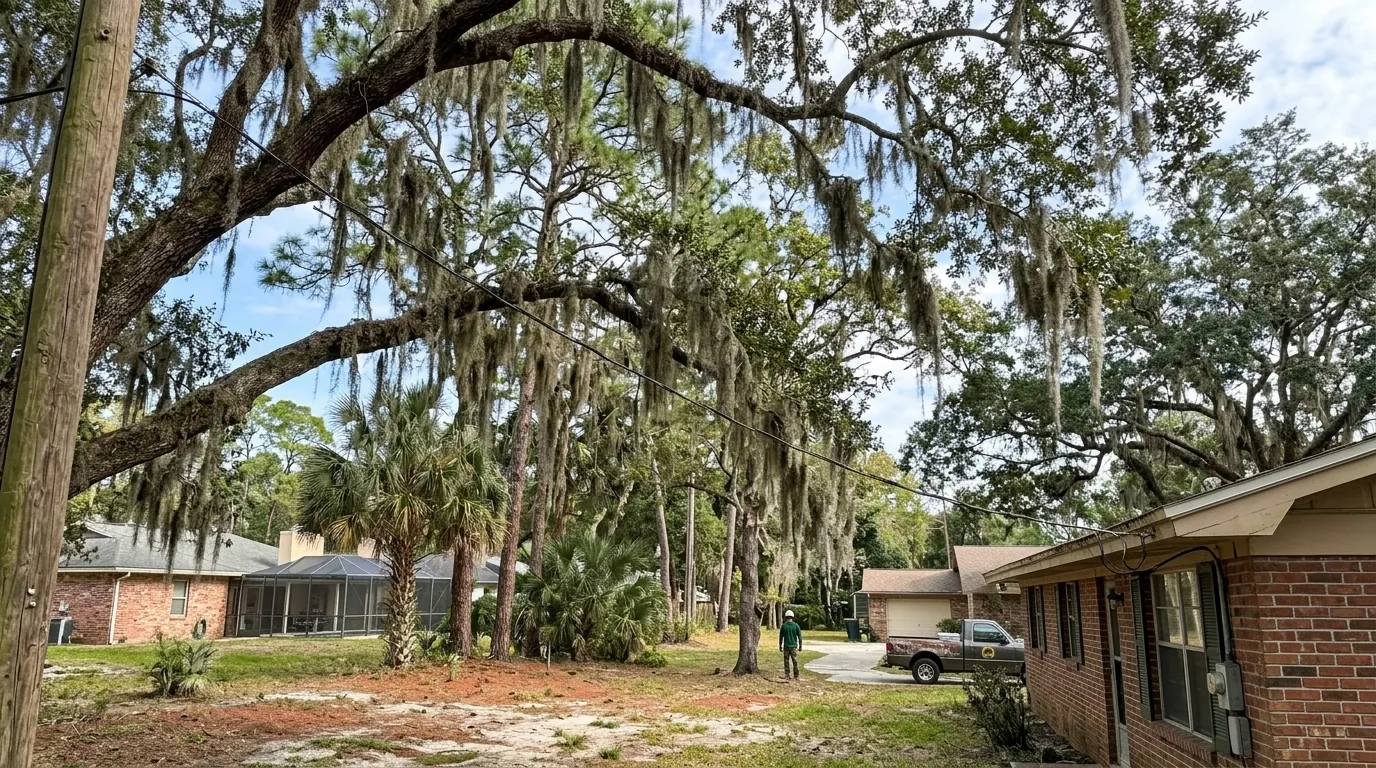
Trees and power lines come down together. If a tree is on a line, call your utility's outage number before anything else. GRU asks customers to report a tree on a power line immediately, and Clay Electric customers should use Clay's outage line. Both numbers are on your bill and the utility's website. No tree crew should start cutting until the utility has made the line safe. Our power line guide explains who handles which wires.
Step 3: Document the Damage for Insurance
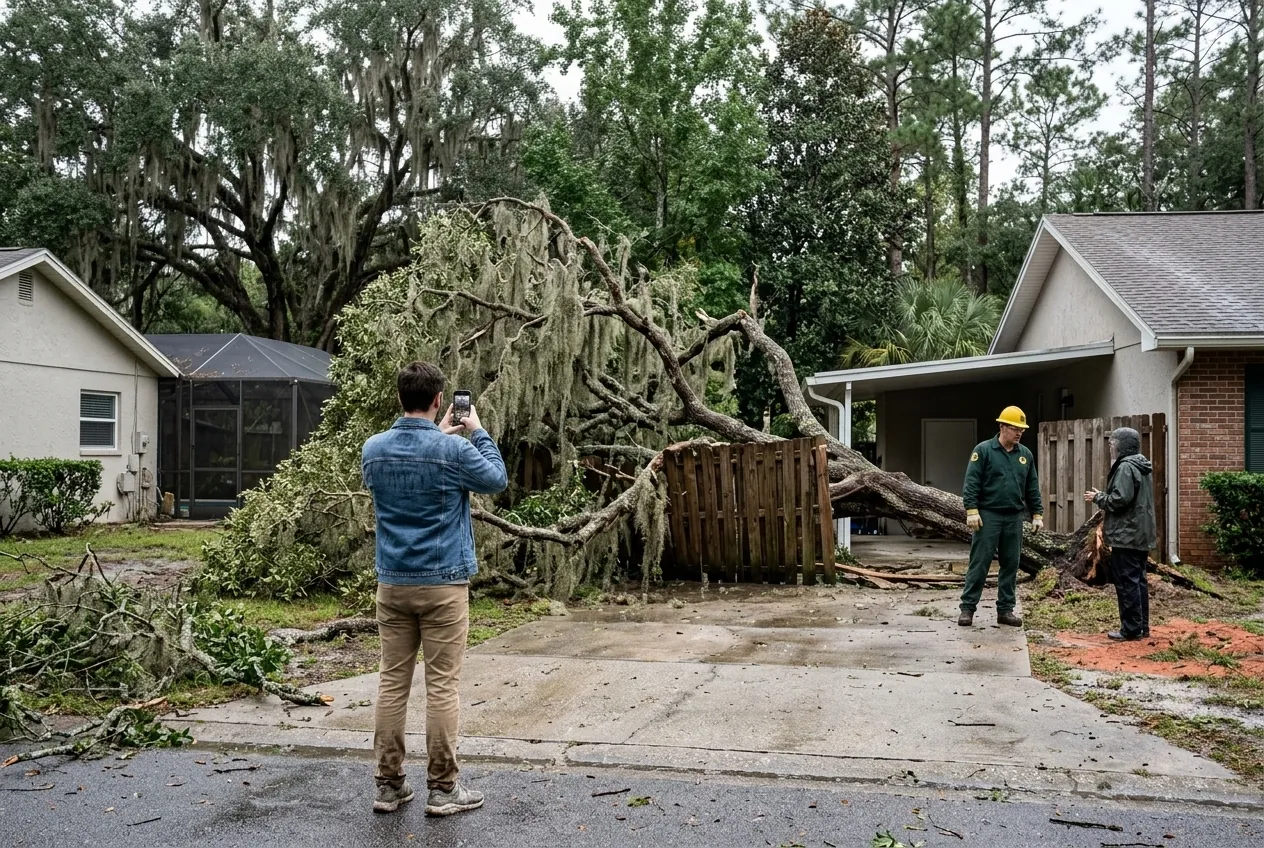
Florida's Department of Financial Services advises taking photos and video of damage before and after any repairs, keeping damaged property when you can, and saving every receipt. Do this before the tree is moved.
- Wide shots of the house from each side showing where the tree landed.
- Close shots of the roof, gutters, windows, fence, car or pool cage where they were hit.
- The base of the tree and the root plate or break, which shows how it failed.
- Inside damage: ceilings, water stains, broken glass.
- A short video walking the whole scene, with the date visible on your phone.
We photograph storm damage for insurance before we cut, and you're welcome to have those photos for your claim.
Step 4: Prevent More Damage
The DFS guidance also says to make repairs needed to prevent further damage and document them, and many policies require it. That usually means tarping a roof opening, boarding a window, or removing the part of a tree that's letting water in. Save receipts for tarps and emergency work. If the tree is resting on the structure, removing it is part of this step, and it needs the right equipment, not a pole saw from the garage.
Step 5: Understand Your Florida Homeowners Insurance Basics
This is general information, not legal or insurance advice. Your policy wording is what counts, so read it or call your agent.

| Question | General answer in Florida |
|---|---|
| Tree fell on the house | Removal from the structure and the structural damage are commonly covered, subject to your deductible |
| Tree fell in the yard, hit nothing | Often not covered, or covered only up to a small debris-removal limit |
| Neighbor's tree fell on my house | Generally your own policy responds, unless the tree owner was negligent, such as ignoring a clearly dead tree |
| Hurricane deductible | Applies to named hurricanes, is usually separate from the all-perils deductible, and may be higher |
| Deadline to report | Notice of a new or reopened claim within 1 year of the date of loss; supplemental claims within 18 months (FS 627.70132) |
| How fast the insurer must act | Acknowledge within 7 days; pay, partly pay, or deny in writing within 60 days |
DFS also notes that the tree and debris removal amount in many policies may not be enough to cover the entire cleanup. If you run into problems, DFS runs a free Insurance Consumer Helpline that can help you understand your options.
Step 6: Get the Tree Off Safely
A tree on a roof is loaded in ways that are hard to read. Cutting the wrong piece first can drop the trunk through the ceiling or roll it off the edge. Our emergency tree removal crew works 24/7 for trees on structures. On most jobs, we stabilize the tree, cut the crown into pieces that can be lowered on rigging, and lift the heavy trunk off with a crane when there is no safe way to roll it. Crane tree removal is often the fastest way to get weight off a damaged roof.
Emergency and after-hours work typically adds 25 to 50 percent to a normal removal price, and a crane adds $600 to $1,800. You'll still get a written price before we start, even at night.
Leaning trees after the wind dies down
A tree that is leaning after a storm and wasn't before is a different case from a tree that has grown at an angle for years. A fresh lean, especially with soil or roots lifted on the side away from the lean, means the root plate has moved and may keep moving as the ground drains. Keep people and cars out of its fall path and have it looked at quickly. Soaked sandy soil gives roots less grip, so the risk is often highest in the days right after heavy rain.
Step 7: Check the Permit Rules After a Storm
Inside the City of Gainesville, Sec. 30-8.7.B.5 lets trees be removed without a permit in advance for the immediate protection of public safety, but the owner must file a permit application on the next city work day, and mitigation can still apply. In unincorporated Alachua County, contact the County Forester about regulated trees. Our Gainesville tree permit guide explains the details. Trees that are down in the road or right-of-way are a city or county matter; the city's Urban Forestry page lists Public Works as the contact for fallen trees in roads.
Step 8: Deal With the Rest of the Yard
Once the house is safe, there's usually more. Hanging limbs (sometimes called widowmakers) caught in the canopy, split trunks, and leaning trees with lifted root plates are all hazards that can fail days later. Storm damage cleanup covers removing hangers, cutting up downed wood and hauling it away.
On debris: Gainesville's rules require contractors to remove the tree debris they generate, and regular curbside yard waste service isn't meant for contractor debris. After big storms, local governments sometimes run separate debris pickups with their own rules, so watch city and county announcements.
Avoiding Storm Chasers in Gainesville
- Get a written, fixed price before any work starts.
- Ask for proof of liability insurance and workers' compensation coverage.
- Be wary of anyone who asks for full payment up front or pressures you to sign that day.
- Read anything you sign carefully, and don't sign over your insurance benefits without understanding what that means.
- Use a local company you can find again after the storm passes.
What to Tell Us When You Call the Storm Line
A few details help us send the right crew and equipment the first time:
- Whether anyone is hurt or still inside the affected part of the house
- Whether any wires are down or touching the tree, and if the utility has been called
- What the tree is on: roof, car, fence, pool cage, driveway
- Rough size of the tree and the trunk, even a guess
- How a truck can reach the house, including gates and soft ground
- A few photos, if it's safe to take them
Before the Next Storm: A Short Checklist
- Read the hurricane deductible and debris-removal limits on your policy now, not after a storm.
- Take dated photos of your house, roof and trees on a calm day so you have a before record.
- Have dead trees and large dead limbs over the house removed before June.
- Know which utility serves your address and where its outage number is.
- Keep a tarp, rope and a working flashlight where you can reach them in the dark.
After the Storm: Getting Ready for the Next One
Once things settle, look at the trees that stayed standing. Laurel and water oaks with decay, dead pines and long live oak limbs over the roof are the usual suspects next time. Our posts on pruning live oaks before hurricane season and laurel oak failure explain what to look for. A typical post-storm call from Kirkwood or Ironwood starts with one tree on a carport and ends with a plan for the two leaning beside it.
For non-emergency work, see our Gainesville tree service page or request a free estimate.