Tree on the house?
 Not on the list?
This is a plain-language summary, not legal advice, and codes change. We read the current rules before every estimate and will tell you if a tree looks regulated. The final word always belongs to the city's Urban Forestry program or the county's tree permitting office, and both publish their contact details online.
Gainesville Tree Permit Rules Start With Your Jurisdiction
A Gainesville mailing address does not mean you live inside the City of Gainesville. Haile Plantation, for example, is an unincorporated community in Alachua County even though residents use Gainesville addresses and the 32608 ZIP code. Large parts of the area west and southwest of the city work the same way. If your property is outside city limits, the county code applies, not the city's.
If you aren't sure, give your address to the city's Urban Forestry program or the county's tree permit office and ask which code applies. Towns such as Newberry, Alachua and High Springs have their own codes, so a third set of rules applies there.
City of Gainesville Tree Removal Permit Rules for Homes
The city's tree rules sit in Chapter 30 of the Land Development Code, mainly Sec. 30-8.7 (Permits for Tree Removal; Mitigation). The key line for homeowners is the single-family exemption in Sec. 30-8.7.B: on property with single-family dwellings, a permit is required only to remove champion or heritage trees.
What counts as a heritage tree in Gainesville
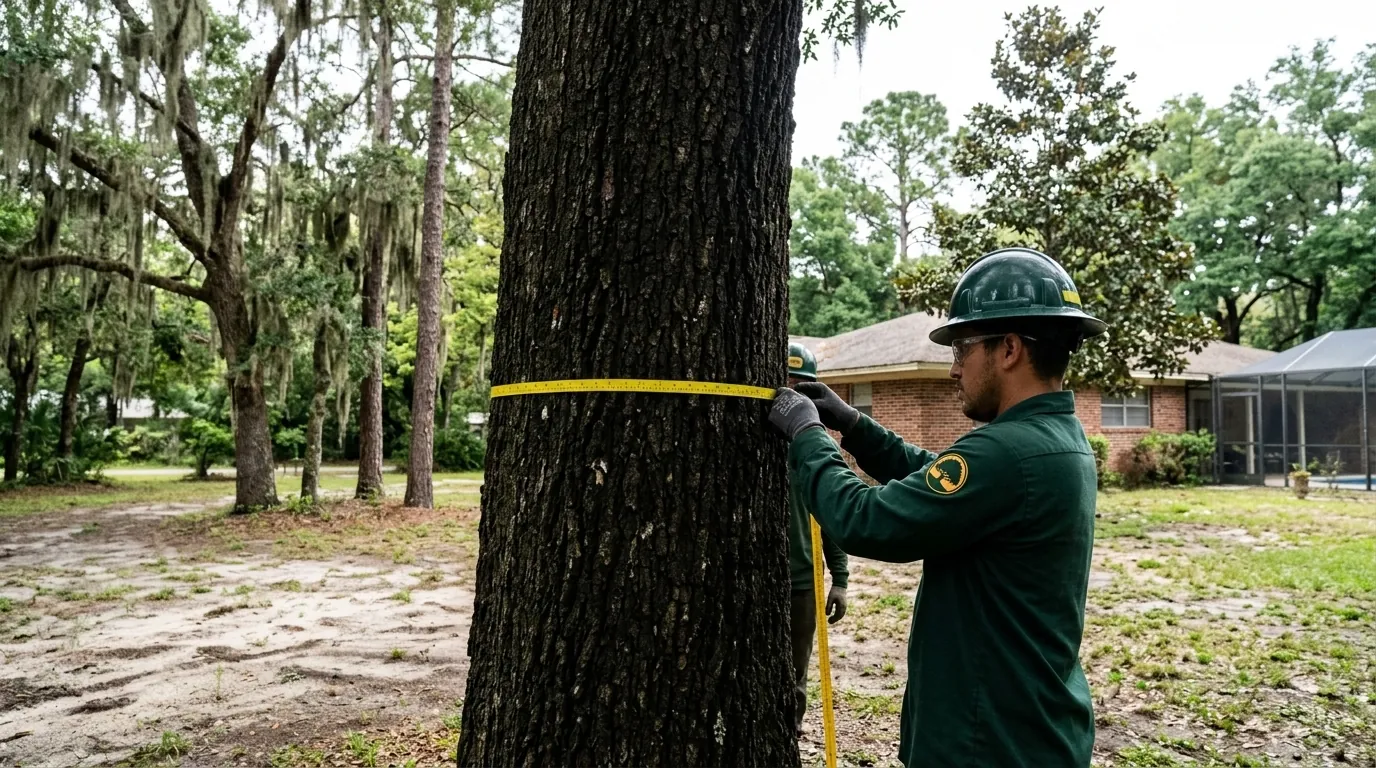
According to the city's single-family permit guide, trees become heritage trees once the trunk is larger than 20 inches in diameter measured 4.5 feet above the ground. Five common species get a higher threshold of 30 inches: water oak, laurel oak, sweetgum, slash pine and loblolly pine.
Where on the lot the tree stands
Location matters too. The city treats some species as High Quality, and those heritage trees are regulated anywhere on the property. Other heritage trees are regulated only inside the legal setback. The High Quality list includes live oak, sand live oak, southern magnolia, longleaf pine, spruce pine, southern red oak, Florida maple, bald and pond cypress, the hickories, pecan, tulip poplar, the elms and the native hollies, among others.
| City of Gainesville, single-family lot | Permit needed? |
|---|---|
| Any tree under 20 in. diameter at 4.5 ft | No |
| Laurel oak, water oak, sweetgum, slash or loblolly pine under 30 in. | No |
| High Quality species (live oak, magnolia, longleaf pine, etc.) over 20 in. | Yes, anywhere on the lot |
| Other species over their heritage size, inside the legal setback | Yes |
| Champion tree | Yes; only the tree advisory board can approve removal |
| Tree in a planned development's approved landscape plan | Possibly at any size; ask the city |
That last row trips people up. The city's guide notes that in a planned development, a tree that is part of the approved landscape plan, such as a street tree or parking-lot tree, can be regulated at any size. There's no application fee listed for single-family permits, but the city can require mitigation planting based on the tree's size, species, condition and location under Sec. 30-8.7.
Dead, Dying and Emergency Trees Inside City Limits
The permit requirement in Sec. 30-8.7.A is written for a living regulated tree. As the code reads, a tree that is fully dead falls outside that sentence, but the city's Urban Forestry page asks residents to call before acting to avoid a violation, and we recommend the same. A tree that is dying is still living.
For true emergencies, Sec. 30-8.7.B.5 lets a tree be removed without a permit in advance for the immediate protection of public health, safety or welfare. The owner must file a permit application on the next city work day, and mitigation still applies. If a storm drops a heritage oak on your roof, protect the house first, take photos, and file the paperwork right after. Our storm guide covers that sequence.
When a permit is needed for a living regulated tree, Sec. 30-8.7.F lists the findings that can support approval, including a safety hazard, a disease that could spread, structural damage, or a tree that prevents reasonable development of the site.
Alachua County Tree Removal Permit Rules Outside City Limits
Unincorporated Alachua County regulates trees under Chapter 406, Article II of its Unified Land Development Code. The county's starting point is stricter than the city's: its permitting page states that tree removal in all land uses and zoning districts is prohibited without prior approval, then sets thresholds for what actually needs a permit.
Sec. 406.11 defines regulated trees as native species 8 inches DBH or larger plus specimen trees listed in Table 406.16.5. Heritage trees are native trees 20 inches DBH or larger, except laurel and water oaks, which qualify at 30 inches. Landmark live oaks are 45 inches or larger with a high condition rating, and champion trees are those recognized by the Florida Forest Service or American Forests as the largest of their species.
| Unincorporated Alachua County | Trees that need a permit |
|---|---|
| Single-family lot, 1 acre or less | Native trees over 20 in. DBH; laurel and water oaks over 30 in.; specimen trees |
| Single-family lot over 1 acre | All trees over 8 in. DBH; specimen trees |
| HOA common property, multifamily, commercial | All trees over 8 in. DBH; specimen trees |
| Application fee (per county page) | $90; several trees can go on one permit |
| Removed without a permit | Replacement at up to double the normal mitigation rate |
Applications go through the county's Citizenserve portal, and the County Forester reviews them. Unlike the city code, Sec. 406.13 does not contain a general dead-tree exemption. Dead or declining trees get the lowest condition rating in the county's tables, and Sec. 406.16.2(c) allows removal permits for trees that are a safety hazard, under pest or fungal attack, or causing progressive structural damage. If a dead tree is on your county lot, plan on contacting the County Forester rather than assuming it's exempt.
Florida Statute 163.045 and the Hazard Tree Exemption
State law adds a route that overrides both local codes in one narrow situation. Under Florida Statute 163.045, a local government may not require a notice, application, approval, permit, fee or mitigation to prune, trim or remove a tree on residential property if the owner has documentation that the tree poses an unacceptable risk to persons or property. The county code repeats this in Sec. 406.13(a).
- Residential property means a single-family detached building on a lot actively used for single-family purposes.
- Documentation must be an onsite assessment following the ISA's Best Management Practices: Tree Risk Assessment, Second Edition (2017), signed by an ISA certified arborist or a Florida licensed landscape architect.
- Unacceptable risk means removal is the only practical way to bring the tree's risk below moderate.
- No replanting can be required for a tree removed under the statute.
This is not a blanket pass for any tree an owner dislikes. A healthy oak that drops acorns on the driveway won't meet the standard. A laurel oak with a hollow base leaning toward a bedroom might. Keep the signed assessment with your property records. If you're not sure where your tree stands, a tree health check during our free estimate will tell you whether it's worth getting a formal risk assessment.
Gainesville HOA Rules for Tree Removal
The state statute limits what a local government can require. It says nothing about homeowners associations, so your HOA's covenants and architectural review rules still apply. Many associations around Gainesville require written approval before a tree comes down, and some require a replacement tree of a set size or species. Ask your management company for the current form before work is scheduled. We're happy to provide a written description of the work and the reason for it for your application.
A Quick Gainesville Tree Permit Checklist
- Confirm whether the parcel is in the City of Gainesville, unincorporated Alachua County, or a town.
- Identify the species. Laurel oak, water oak, sweetgum and the two common pines have higher thresholds in the city.
- Measure the trunk diameter at 4.5 feet. Circumference divided by 3.14 gives you diameter.
- Note where the tree stands relative to the setback if you're in the city.
- Check HOA covenants and get written approval if required.
- If the tree is a hazard, consider a signed risk assessment under FS 163.045.
- Apply, get approval, then schedule the removal.
Permits are only one part of the job. For what the removal itself costs, see our Gainesville tree removal cost guide, and for the work itself, our tree removal and oak tree removal pages explain how we take trees down over houses and pools. You'll find the rest of our Gainesville tree service work on the main page.