Tree on the house?
 Not on the list?
Loblolly, slash and longleaf pines are part of almost every lot around Gainesville. When one starts to fade, the first question is usually about bugs. The honest answer from UF/IFAS is that bark beetles show up in every dying pine, but in most cases they are a symptom of stress, not the cause. The exception is southern pine beetle, which can spread to healthy trees. Knowing which one you have changes what you should do next.
Pine Beetles in Alachua County: The Usual Suspects
UF/IFAS lists five common southern pine bark beetles: three Ips engraver species (the sixspined, eastern fivespined and small southern pine engravers), the southern pine beetle, and the black turpentine beetle. All three Ips species occur throughout Florida wherever pines grow. Southern pine beetle is found across north Florida, and Alachua County is inside the Florida Forest Service's southern pine beetle program area.
| Beetle | What it attacks | Key signs | Spreads to healthy pines? |
|---|---|---|---|
| Southern pine beetle | Pines of any vigor during outbreaks, often in groups | Many popcorn-size pitch tubes in bark crevices up the trunk; winding S-shaped galleries | Yes, during outbreaks |
| Ips engravers | Stressed, injured or recently cut pines | Reddish boring dust; dime-size pitch tubes on bark plates; Y, I or H-shaped galleries | Rarely; mainly stressed trees |
| Black turpentine beetle | Lower trunk of stressed pines | Large resin masses near the base, rarely above about 8 feet | Rarely |
Ips Engraver Beetles: The Most Common Pine Beetle Near Gainesville
UF/IFAS says Ips beetles usually colonize trees already weakened by drought, lightning, root injury, disease or construction. They are also attracted to the smell of fresh pine, which is why they move into cut logs and slash. When their numbers get high they can overwhelm healthy-looking trees nearby, but those outbreaks stay small and short compared with southern pine beetle.
In warm weather, Ips can complete a generation in about 25 days, and the small southern pine engraver in as little as 18, so populations build quickly in summer. Signs to look for:
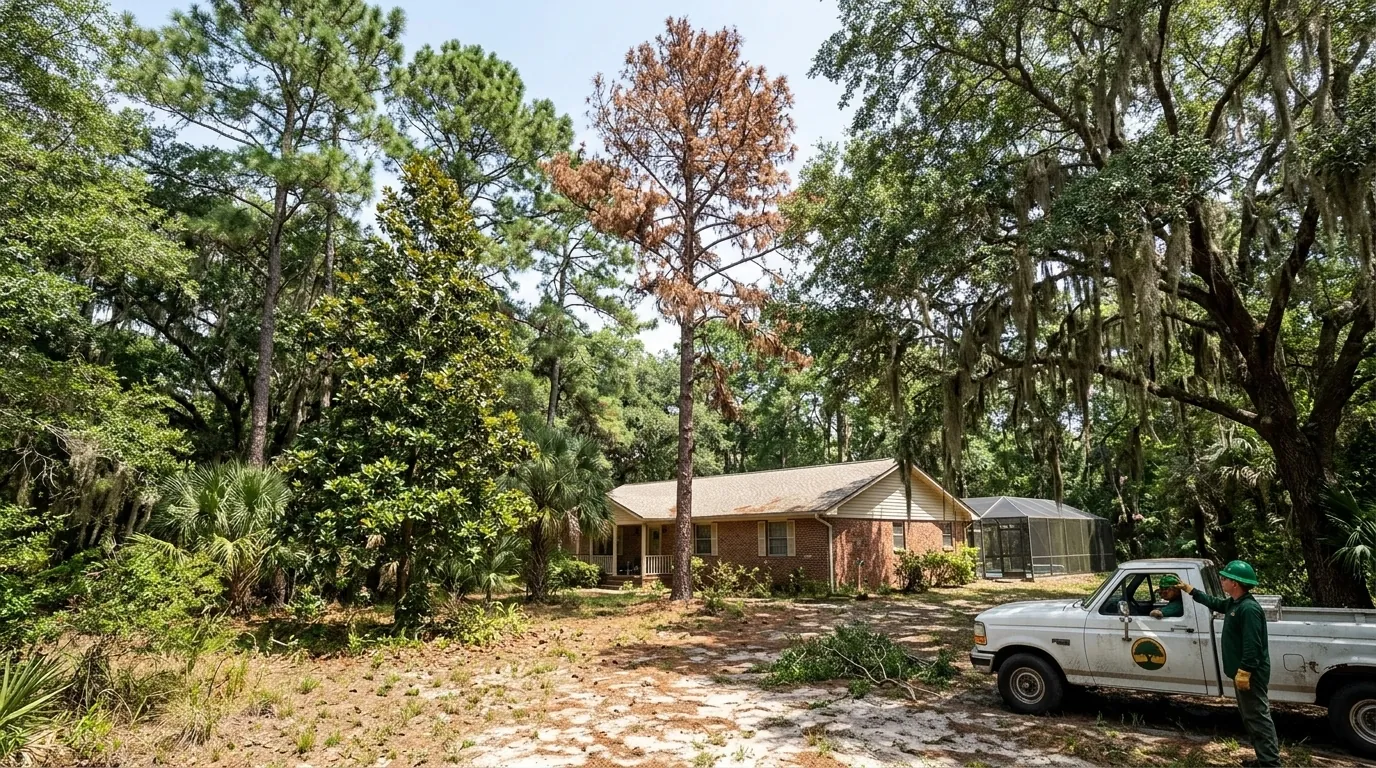
- Needles fading from green to yellow to reddish-brown, which UF/IFAS says can happen in two to four weeks in warm weather
- Reddish-brown boring dust in bark cracks, on spider webs or on plants below the tree
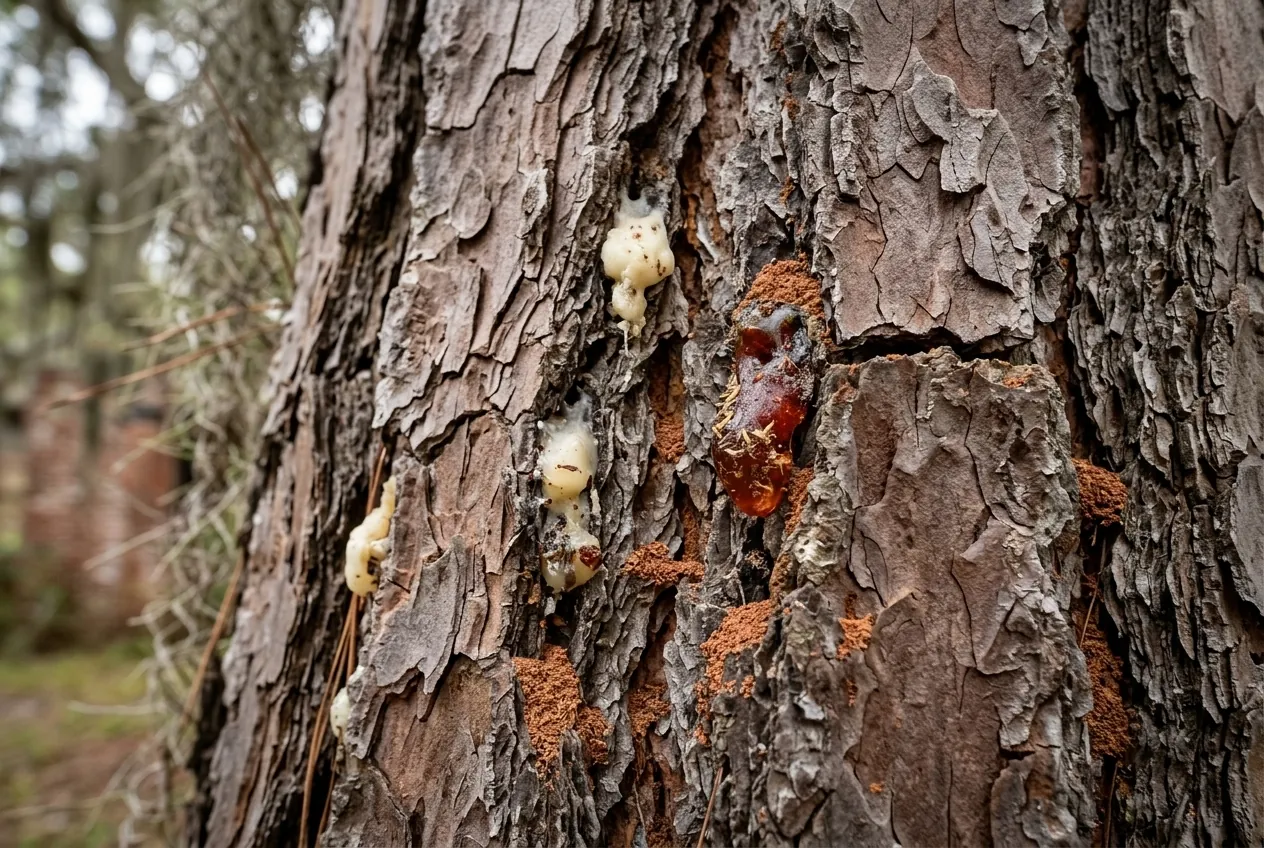
- Small whitish or reddish resin globs, about the size of a dime, mostly on the surface of bark plates
- Small round exit holes in the bark after the beetles leave
In winter, color change can take months, and the beetles have often left by the time the needles fade.
Southern Pine Beetle in Alachua County: When Speed Matters
Southern pine beetle is the one to take seriously. UF/IFAS calls it the only pine bark beetle in the Southeast that can cause an epidemic. It attacks in large numbers over a few weeks, kills pines in groups called spots, and can have as many as seven generations a year in Florida. Florida lost an estimated $38 million to it across 17,599 acres in 2001.
Signs that point to southern pine beetle rather than Ips:
- Dozens or hundreds of small, popcorn-shaped resin masses scattered up the trunk, mostly tucked in the crevices between bark plates
- Pitch tubes that can run from near the ground to 60 feet up
- Winding, S-shaped tunnels that cross each other under the bark
- Several pines dying close together in a short time
UF/IFAS guidance is direct: if you see these signs north of Orlando, remove the infested tree promptly, and check neighboring pines for fresh resin. Insecticides only work as prevention before an attack. Once southern pine beetle has colonized a tree, it can't be saved.
Dead Pine Removal in Alachua County: How Fast?
The UF/IFAS decision guide for homeowners ties urgency to the needle color and which beetle is present:
| What you see | What it likely means | What to do |
|---|---|---|
| Green needles, fresh pitch tubes or dust | Beetles active now; new brood may be developing | Get it diagnosed quickly; if southern pine beetle, remove promptly |
| Yellow to red needles | Advanced colonization; brood may have already emerged | Remove; check neighboring pines for new resin |
| Gray, drooping, dead needles | Beetles have left; predators remain | No beetle urgency, but plan removal if it can hit anything |
| Dead for months, bark loosening | Wood is drying and weakening | Remove before it fails; climbing is no longer safe |
That last row is where most of our pine calls come from. A dead pine dries out and turns brittle, and the top can snap in a summer thunderstorm. It also becomes harder and more expensive to remove because a climber can't safely tie into it. We often use a bucket truck or crane on long-dead pines near houses. Our pine tree removal page covers how we handle them, and typical removals for loblolly or slash pine run $600 to $2,400.
Lightning, Construction and Black Turpentine Beetles
Two common local triggers deserve their own mention. Lightning strikes are a frequent starting point: UF/IFAS notes that both Ips and southern pine beetle are drawn to pines injured by lightning or fire. A pine with a long spiral scar down the trunk after a summer storm should be watched closely for boring dust over the next few weeks. Construction is the other. New driveways, pools, room additions and trenching for utilities all cut or compact pine roots, and an Ips attack a season or two later is a common result.
The black turpentine beetle leaves a different signature. UF/IFAS describes large resin flows at the base of the tree, rarely above about eight feet. It rarely becomes epidemic. The guidance is to remove the affected pine, though not as an emergency, and to watch the pines around it. This is the one situation where UF/IFAS says a preventive insecticide applied to the base of neighboring trees may help.
Why dead pines come down in short pieces
A pine that has been dead for a few months loses moisture fast, and the top and limbs can snap off unexpectedly when the trunk moves. That changes how we work. Instead of a climber going up the tree, we usually work from a bucket truck or use a crane, and take the tree down in short, light sections so nothing large swings toward the house.
Keeping Beetles Out of Healthy Pines Around Gainesville
UF/IFAS recommends these steps for pines in residential landscapes:
- Don't compact, dig through or pave over the root zone. Construction near pines is one of the most common triggers for Ips attacks.
- Give pines room. UF/IFAS suggests 15 to 20 feet between trees.
- Keep competing vegetation down under pines.
- Use pine straw or pine bark mulch over the root zone instead of turf that needs frequent irrigation.
- Water deeply during long dry spells.
- After a pine removal, don't leave fresh logs or slash stacked in the yard during warm months, since the smell draws Ips beetles.
That sixth point is one reason our removal price includes hauling the wood. A pile of fresh pine rounds next to your remaining pines is an open invitation.
Pine Removal Rules in Gainesville and Alachua County
Inside the City of Gainesville, slash and loblolly pines on single-family lots don't become heritage trees until 30 inches in diameter, while longleaf pine is on the city's High Quality list and is regulated anywhere on the lot above 20 inches. In unincorporated Alachua County, native trees over 20 inches on lots of an acre or less need a permit, and dead trees aren't automatically exempt. Our tree permit guide covers both.
Help for Larger Pine Acreage
If you own pine woods on acreage around Archer, Hawthorne or elsewhere in the county, the Florida Forest Service runs a Southern Pine Beetle Assistance and Prevention Program for non-industrial private forest landowners. Its published minimum tract size is 10 acres, or 5 acres for a first pulpwood thinning, and applications open during a yearly sign-up window. Your county forester is the contact. For thinning or clearing dead pines across a lot, see land clearing.
UF and the Florida Forest Service also run a free online Tree Health Diagnostics Forum where you can post photos of a struggling pine and get an opinion.
Getting a Dying Pine Looked At
If you have a pine that's fading, we'll look at the bark, the needles and the trees around it as part of a free estimate, and tell you whether it needs to come down now or can wait. Call or text us, or send a photo for a quote. You can see the rest of our tree service in Gainesville on the main page.